
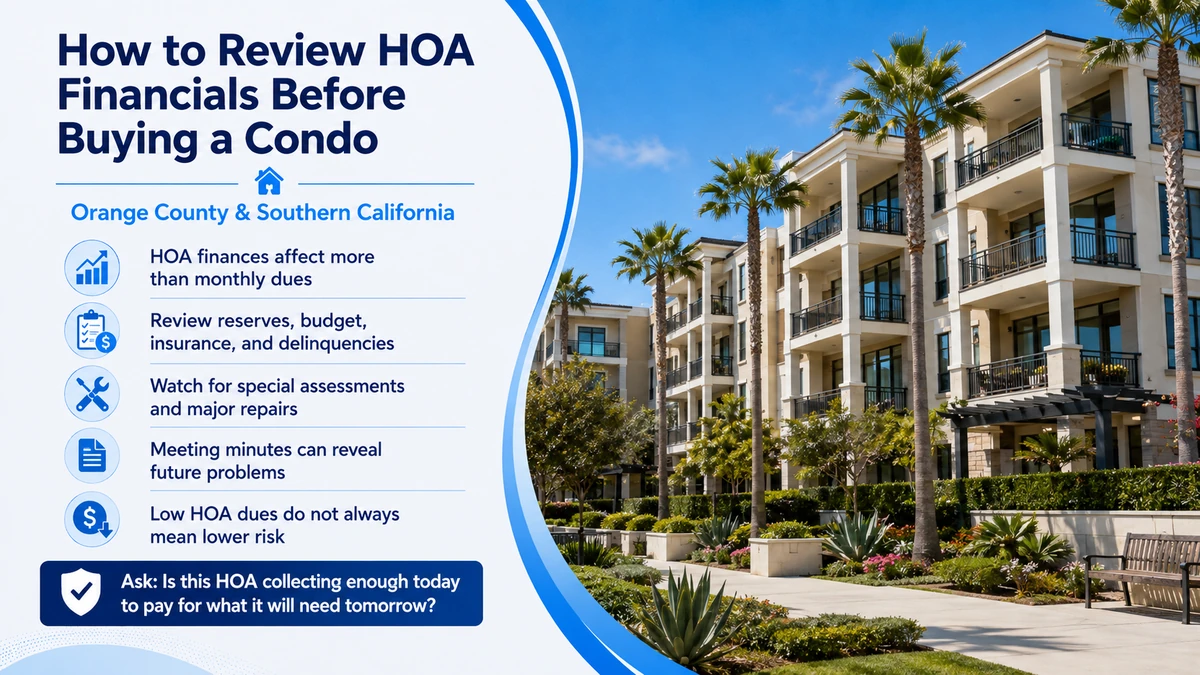
A condo can look well maintained and still have financial problems behind the scenes.
The landscaping may look good. The pool may be clean. The monthly HOA dues may even seem reasonable.
But none of those things tell you whether the association has enough money saved for the next roof replacement, exterior repair, insurance increase or other major expense.
One thing we often see buyers focus on too heavily is price.
The condo price matters, but when you buy into an HOA, you are also taking on your share of the association's future financial obligations.
That is why HOA financial documents deserve a careful look during escrow.
Why Do HOA Financials Matter?
Depending on the development, the HOA may be responsible for major parts of the community, including:
- Roofs
- Exterior paint and siding
- Balconies
- Landscaping
- Pools and common areas
- Private streets
- Common plumbing
- Elevators in larger buildings
- HOA insurance
- Other shared components
Two Orange County communities with similar monthly dues can have very different financial obligations.
One HOA may maintain little more than landscaping and common areas.
Another may be responsible for roofs, siding, streets, balconies, plumbing and extensive amenities.
The more the association is responsible for, the more important it becomes to understand whether it is collecting and saving enough money.
Start With the HOA Reserve Study
The reserve study is one of the most useful documents in the HOA package.
Reserves are money set aside for major repairs and replacements that do not occur every year.
The reserve study generally helps identify:
- Major components the HOA is responsible for
- Their estimated remaining useful life
- Expected repair or replacement costs
- Current reserve funds
- Recommended future reserve contributions
A large reserve balance does not automatically mean the HOA is financially strong.
Imagine an association has:
$900,000 in reserves
That sounds substantial.
But suppose the reserve study expects:
$600,000 of roof work
and
$500,000 of exterior and balcony work
over the next several years.
Suddenly, $900,000 does not look as large.
That is why buyers should ask:
How much has the HOA saved compared with what it expects to spend?
What Does “Percent Funded” Mean?
Some reserve studies include a percent funded figure.
Generally, this compares the HOA's actual reserve balance with the amount the reserve analysis estimates ideally would have accumulated at that point.
It can be useful, but it should not be treated like a school grade.
An HOA does not automatically have a problem simply because it is less than 100% funded.
Likewise, one percentage does not tell you everything.
A better review looks at:
Percent funded + upcoming projects + annual contributions + funding trend
An HOA with lower reserves but manageable upcoming expenses and a strong plan to increase contributions may be in a better position than the percentage initially suggests.
The more concerning situation is usually:
Very low reserves + major repairs approaching + insufficient contributions + no clear funding plan
For a deeper discussion of this issue, see How Underfunded HOA Reserves Can Cost Condo Owners Money in Orange County.
What We've Actually Seen in Orange County
The differences between HOA financial packages can be dramatic.
In one Fullerton HOA package we reviewed, the association was approximately 14% funded.
The monthly dues looked relatively attractive, but the reserve position and upcoming obligations told a much less comfortable story.
That does not mean a 14% funded HOA automatically requires a special assessment.
It does mean we want to look much more closely at what repairs are coming and how the association expects to pay for them.
In another HOA package we reviewed in Anaheim, the association was approximately 95% funded.
That did not make the HOA automatically perfect either.
But it meant the association had substantially more money accumulated relative to its projected reserve obligations.
The lesson is not:
95% good, 14% bad.
The lesson is:
The monthly dues and purchase price do not tell you the financial condition of the HOA.
You have to read the documents.
Look at the Annual Reserve Contributions
The current reserve balance tells you where the association is today.
The annual contribution tells you something about where it may be going.
Suppose an HOA is currently underfunded but is increasing reserve contributions each year.
That may show the association has recognized the problem and is trying to improve its position.
Another HOA could have a reasonable reserve balance today but be contributing too little to keep up with future expenses.
Ask:
- How much is being added to reserves each year?
- Is that amount increasing?
- Does the reserve study recommend more?
- Is the funding position improving or declining?
The direction can sometimes be as important as the current balance.
Review the Operating Budget Separately
Reserve funding is only part of the financial picture.
The operating budget covers normal recurring expenses such as:
- Insurance
- Landscaping
- Utilities
- Management
- Routine repairs
- Pool expenses
- Legal and accounting costs
Look at whether normal income appears sufficient to cover normal expenses.
If an HOA regularly spends more than it collects, ask how the difference is being handled.
A balanced operating budget also does not necessarily mean the association is healthy.
An HOA can pay today's bills while failing to save enough for tomorrow's roof.
The operating budget and reserve plan need to make sense together.
Put a Reserve Shortage Into Perspective
Large HOA numbers can feel abstract.
One rough way we sometimes look at a reserve shortage is to divide it by the number of units.
We reviewed one smaller association with approximately:
25 units
and roughly:
$300,000 in reserve underfunding
A simple calculation is:
$300,000 ÷ 25 = $12,000 per unit
That does not mean every homeowner is about to receive a $12,000 special assessment.
The HOA may address the shortage through higher dues, larger reserve contributions, borrowing, a special assessment or a combination of those approaches.
Assessment obligations may also differ depending on the association.
But converting the shortage to a rough per-unit number can help a buyer understand the scale of the financial exposure.
A $300,000 HOA shortage sounds distant.
$12,000 per unit feels much more relevant to the person considering buying there.
Check for Special Assessments and HOA Loans
A special assessment is an additional charge beyond regular HOA dues.
If one has already been approved, buyers should understand:
- How much it is
- What project it is funding
- How long payments continue
- Whether additional assessments are being discussed
Do not stop with assessments that have already been approved.
The reserve study and meeting minutes may show that a major project is approaching before the board has decided exactly how it will be funded.
Also look for HOA loans.
Borrowing can allow an association to complete necessary work without collecting a large amount from homeowners immediately.
But the loan still has to be repaid, usually through future HOA revenue.
A loan is not automatically a problem. It is simply another obligation that should be understood.
Check Owner Delinquencies
An HOA depends on owners paying their dues.
If a meaningful amount of assessments is unpaid, the association still needs to pay for maintenance, insurance and other expenses.
The important question is not whether any homeowner is behind.
That happens.
Look instead at whether delinquencies are large enough to put meaningful pressure on the association's cash flow.
Delinquencies may also matter to certain condo lenders, which is another reason the financial condition of the HOA can affect more than just future dues.
Read the Meeting Minutes
Financial statements tell you what has happened with the money.
Meeting minutes can sometimes tell you what may happen next.
Look for repeated discussions about:
- Roof leaks
- Water intrusion
- Balconies
- Plumbing
- Exterior repairs
- Insurance increases
- Reserve shortages
- Special assessments
- HOA loans
- Litigation
- Deferred maintenance
One mention of a repair does not necessarily indicate a major problem.
Repeated discussion of the same expensive issue without a clear funding plan deserves more attention.
The important point is to look for expenses that may not yet be obvious in the current budget.
HOA Insurance Can Change the Financial Picture
Insurance is now a meaningful expense for many associations.
A large increase in the HOA's master-policy premium may leave the board with several choices:
- Increase dues
- Reduce spending elsewhere
- Increase deductibles
- Adjust coverage
- Contribute less toward other needs
This is one reason insurance and reserves should not be viewed separately.
They compete for the same HOA dollars.
For more detail, see Condo Insurance vs. HOA Master Insurance: What California Buyers Should Know.
Low HOA Dues Are Not Automatically Better
It is easy to compare:
HOA A: $350 per month
with:
HOA B: $500 per month
and conclude the first condo is cheaper.
Maybe it is.
But HOA B may be paying for more maintenance, stronger insurance coverage and larger reserve contributions.
HOA A may be keeping dues low while postponing increases that will eventually be necessary.
This is why buyers should ask:
What am I getting for these dues, and is the association collecting enough money to meet its obligations?
The HOA payment is one piece of the home's total cost. For a broader comparison of taxes, insurance, HOA dues, assessments and maintenance, see The True Cost of Owning a Home in Orange County.
Eight Questions to Ask After Reviewing the HOA Financials
You do not need to become an accountant.
After reviewing the documents, try to answer these questions:
- What major repairs are coming?
- How much has the HOA saved for them?
- Is the association contributing enough to reserves each year?
- Are regular dues covering normal operating expenses?
- Are owner delinquencies creating financial pressure?
- Are there special assessments, HOA loans or other major obligations?
- Is important maintenance being postponed?
- Could any of these issues affect my financing, insurance, future costs or resale?
If you cannot answer those questions from the documents, that may be a reason to investigate further.
You Are Buying More Than the Condo
When buyers compare condos, most of the attention naturally goes to:
Price + Location + Floor Plan + Condition
Those things matter.
But with an HOA property, another part of the equation is:
What financial obligations am I buying into?
A beautiful condo can still become expensive if the association has not prepared for major repairs.
A condo with somewhat higher monthly dues may be the better value if the association is financially prepared for its responsibilities.
The goal is not to find a perfect HOA.
It is to understand the association well enough to decide whether the property, price, monthly costs and financial risks make sense together.
For the broader home-buying picture, see Buying a Home in Orange County: What Buyers Should Know.
For additional Orange County housing market data and analysis, visit Legacy Real Estate Insights.

Legacy Real Estate does not provide insurance, legal, tax or financial advice.