A rental property can look great in a spreadsheet.
The rent is strong. The purchase price seems reasonable. The estimated cash flow works.
Then the insurance quote comes back much higher than expected.
For investors in Orange County and Southern California, insurance is one of the expenses that should be investigated before deciding whether a property actually works as an investment.
The right question is not simply:
How much rent will this property generate?
It is:
What will I actually keep after the costs of owning it?
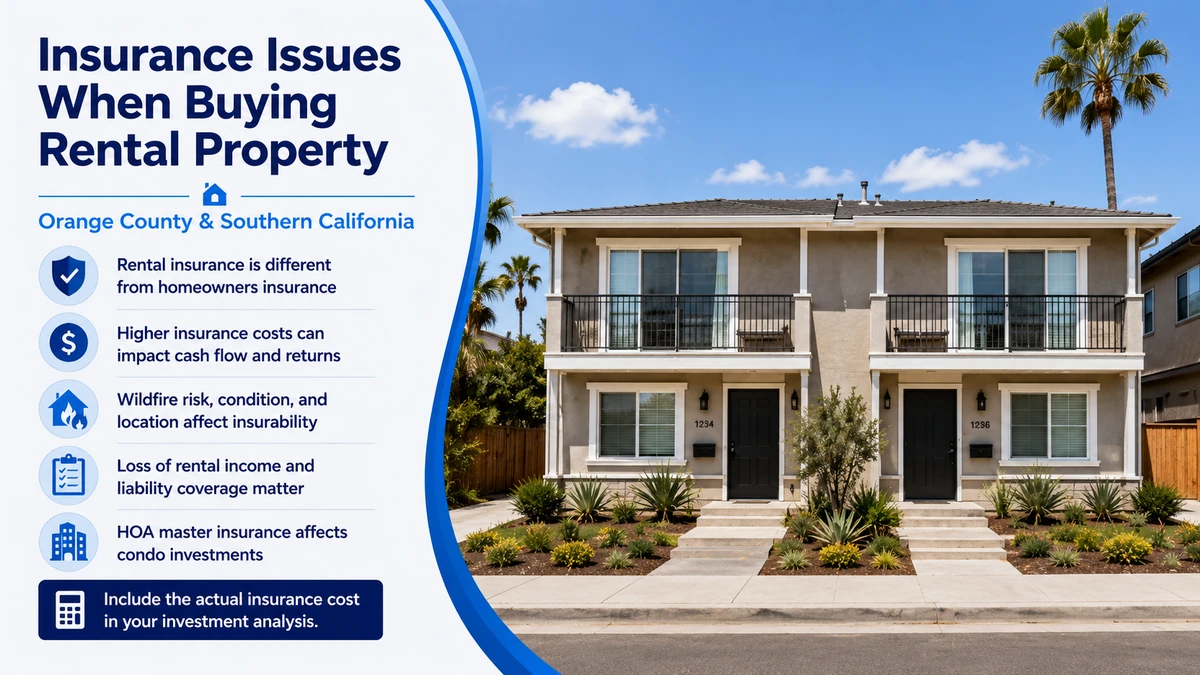
Rental Property Insurance Is Different From Homeowners Insurance
A homeowners policy is generally designed for a home occupied by its owner.
A property occupied by tenants usually needs insurance designed for a rental, often referred to as landlord or dwelling insurance.
Depending on the policy, coverage may include:
- The dwelling
- Other structures
- Property belonging to the landlord
- Liability
- Loss of rental income after certain covered losses
- Certain repair or rebuilding costs
Coverage varies by insurer and policy.
Investors should review the actual coverage with a qualified insurance professional rather than assume that insurance for a rental will cost the same as insurance for a home they live in.
Insurance Can Change the Investment Math
Consider a rental that produces:
$4,000 per month in rent
That equals:
$48,000 per year in gross rental income
But gross rent is not profit.
The property may also have:
- Property taxes
- Insurance
- HOA dues
- Repairs
- Maintenance
- Property management
- Vacancy
- Future capital improvements
Suppose the investor estimated insurance at $2,000 per year.
The actual quote comes back at:
$5,500 per year
That is an additional:
$3,500 per year
coming directly out of the property's return.
If the original cash-flow estimate was only a few hundred dollars per month, that difference could materially change the investment.
This is why rental analysis should use the actual expected expenses, not just estimates copied from another property.
A Common Southern California Investment Scenario
Imagine an investor finds a home in an area with strong rental demand.
The projected rent looks good and the purchase price initially appears to produce acceptable cash flow.
But the property is near open space and has an older roof.
When the investor begins shopping for insurance, the available coverage costs substantially more than expected.
That does not automatically make the property a bad investment.
It means the investor needs to run the numbers again.
If the return still makes sense using the real insurance expense, the property may still be attractive.
If the return disappears once realistic costs are included, the investor has learned something important before completing the purchase.
What Can Make a Rental Property More Expensive to Insure?
Insurance companies use their own underwriting standards, but issues can include:
- Wildfire or brush exposure
- Roof age and condition
- Older electrical or plumbing systems
- Previous insurance claims
- Overall property condition
- Number of units
- Rebuilding cost
- Vacancy
- Short-term versus long-term rental use
- Previous insurance non-renewals
Two Orange County rental properties with similar values and similar rents can therefore have very different insurance costs.
For properties near hillsides or open space, investors can review general wildfire information through CAL FIRE's Fire Hazard Severity Zone maps and the Orange County Fire Authority.
But an actual insurance quote for the specific property is far more useful when calculating investment returns.
What About Loss of Rental Income?
A rental property's income may stop temporarily after a serious covered loss.
The mortgage, taxes and other expenses generally do not.
That is why investors may want to discuss loss-of-rental-income coverage with their insurance professional.
Depending on the policy, coverage may help replace qualifying rental income while a property cannot be occupied after a covered loss.
An investor should understand:
- How much coverage is provided
- How long coverage can last
- What events qualify
- What exclusions apply
This becomes more important when the property's cash flow is needed to cover a mortgage or other ongoing expenses.
Liability Is Part of Rental Ownership Too
Rental property ownership also creates liability exposure.
A tenant, guest or other person could be injured at the property.
Examples might include problems involving:
- Stairs
- Walkways
- Property defects
- Maintenance issues
- Common areas
Landlord policies commonly include some liability coverage, but limits and exclusions vary.
Investors with multiple properties may also discuss umbrella coverage or other liability protection with their insurance professional.
These are insurance decisions, but they are also part of understanding the true cost and risk of owning the investment.
Buying a Condo as a Rental Property?
A rental condo adds another layer.
The investor may carry an individual condo or landlord policy while the homeowners association maintains a master insurance policy for parts of the development.
That means the investor has to evaluate both.
HOA insurance can affect:
- Monthly HOA dues
- Deductibles
- Special assessments
- Financing
- The association's overall financial condition
A condo may have inexpensive individual insurance but still become more expensive to own if the HOA's master-policy premium rises sharply.
This is why condo investors should review the HOA's insurance together with its budget, reserves and other financial documents.
We cover this issue in more detail in Condo Insurance vs. HOA Master Insurance in Orange County: What Buyers Should Know.
What If Traditional Insurance Is Difficult to Obtain?
Some rental properties may have fewer traditional insurance options because of wildfire exposure, property condition or other underwriting concerns.
An insurance professional may need to investigate other carriers, specialty markets or, when applicable, the California FAIR Plan.
Additional coverage may also be necessary.
If a property requires a more complicated insurance package, investors should focus on the combined annual cost, not just one piece of the coverage.
Any proposed insurance should also be reviewed with the lender when financing is involved.
For more detail on this issue, see Buying a Home With FAIR Plan Insurance in Orange County.
Run the Numbers Before You Buy
Before purchasing a rental property, investors should consider:
- Getting an insurance quote early in escrow
- Telling the insurer that the property will be tenant occupied
- Asking whether the quote is still subject to inspection or underwriting
- Understanding the annual premium and deductible
- Reviewing liability coverage
- Asking about loss-of-rental-income coverage
- Confirming lender requirements
- Reviewing HOA insurance when purchasing a condo
- Using the actual premium in the cash-flow calculation
- Considering how higher future expenses could affect the investment
A rental that appears profitable before expenses can look very different after realistic costs are included.
Gross Rent Is Not the Investment Return
Investors naturally pay attention to rent.
But the more useful calculation is closer to:
Rental Income − Taxes − Insurance − HOA − Maintenance − Vacancy − Management − Other Expenses
Insurance is only one part of that equation.
But it can be large enough to turn a marginal investment into one that no longer works.
It can also help an investor compare two properties more accurately.
A home producing slightly higher rent may not be the better investment if it also has significantly higher insurance, HOA or maintenance expenses.
For a broader discussion of how insurance is affecting local real estate, read How California Home Insurance Is Affecting Home Sales.
Look at What the Property Actually Produces
A good rental property is not simply one that collects a lot of rent.
It is one where the relationship between purchase price, income, expenses, risk and future maintenance makes sense.
That is why insurance should be investigated before an investor becomes too committed to the numbers originally placed in a spreadsheet.
At Legacy Real Estate, we look at rental properties through that broader lens: what is the property worth, what income can it reasonably produce, what will it cost to own, and what risks come with it?
You can explore additional market and ownership analysis through Legacy Real Estate Insights.
Before deciding whether a rental property works, run the numbers using the expenses the property is actually likely to have.

Legacy Real Estate does not provide insurance, legal, tax or financial advice.