Homeowners insurance used to be one of the more routine parts of buying a home in Orange County.
That has changed.
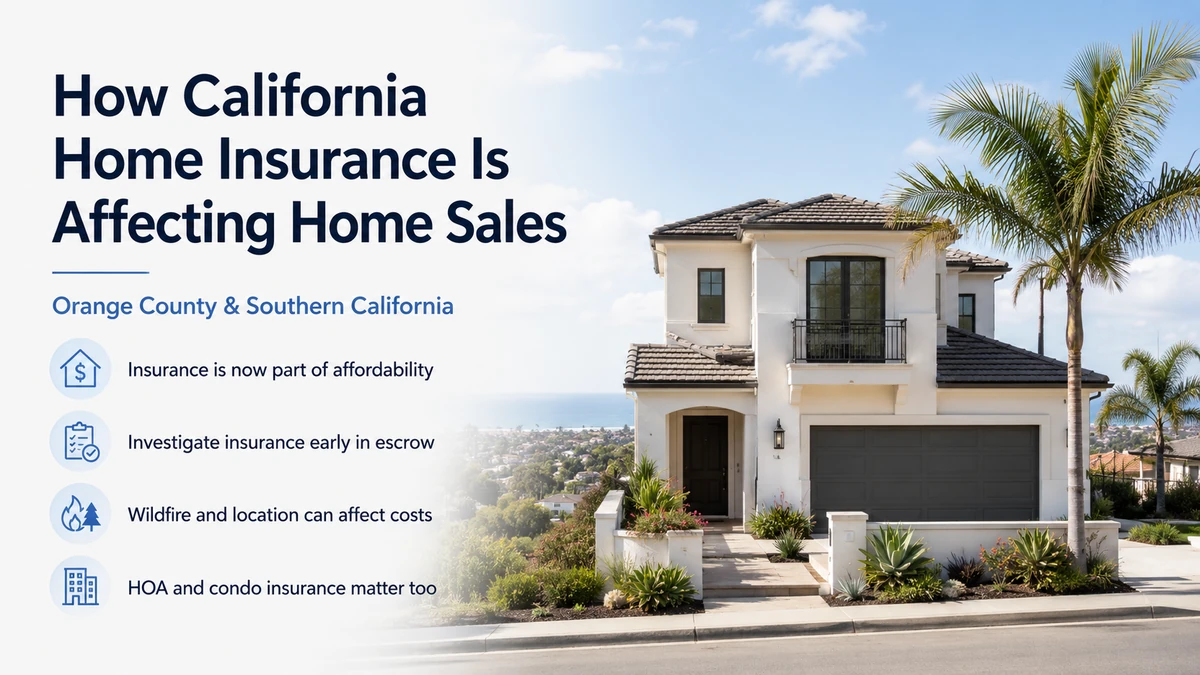
Today, the cost and availability of insurance can affect affordability, financing, escrow and even how buyers compare one property with another.
A home near hills or open space may have very different insurance options from a similar home a few miles away. An older roof, previous claim or other property characteristic can also change what coverage is available.
For buyers and sellers, homeowners insurance is no longer just a policy to arrange before closing. It has become another factor in determining what a home costs to own and how easy it may be to sell.
Why Is Home Insurance Affecting Orange County Real Estate?
California's homeowners insurance market has changed significantly in recent years.
Wildfire losses, higher rebuilding costs and changing insurance-company underwriting standards have contributed to higher premiums and fewer insurance options for some properties.
That matters to real estate because a buyer can:
- Qualify for a mortgage
- Agree on a purchase price
- Complete inspections
- Review disclosures
- Prepare to close
and still encounter an insurance problem.
For a financed purchase, the lender will generally require acceptable homeowners insurance before funding the loan.
An insurance issue can therefore become an escrow or financing issue.
Insurance Can Vary From One Property to Another
Orange County contains many different types of homes and neighborhoods.
Some properties are in established suburban areas. Others are near hillsides, canyons, brush or open space. The county also has a large number of older homes, condos and planned communities.
Insurance companies may consider factors such as:
- Wildfire exposure
- Roof age and condition
- Electrical and plumbing systems
- Previous claims
- Property condition
- Rebuilding cost
- Vegetation and nearby open space
- Individual carrier guidelines
This means two homes in the same city can receive very different insurance quotes.
That is why buyers should investigate the specific property rather than assume insurance will be easy or difficult based only on the neighborhood.
What We've Seen in Orange County
In a recent Orange County transaction, a buyer began investigating homeowners insurance early in escrow because the property was close to open space.
The first insurance option was much more expensive than expected.
Because the issue was discovered early, the buyer had time to compare alternatives and understand the home's actual ownership cost before making final decisions.
Experiences like this are why we increasingly view homeowners insurance as part of the buyer's property investigation during escrow, not simply something to arrange right before closing.
Insurance Is Now Part of Home Affordability
Consider two Orange County homes priced at $1.1 million.
Both have similar square footage and fit the buyer's price range.
Home A
Homeowners insurance:
$2,000 per year
Approximately:
$167 per month
Home B
The second property is closer to hills or open space.
Available insurance:
$6,500 per year
Approximately:
$542 per month
The difference is:
$375 per month
or:
$4,500 per year
The homes have the same purchase price.
They do not have the same cost of ownership.
Home B may still be the better property. It could have a better view, larger lot or more desirable location.
But the buyer should understand that added expense before deciding what the property is worth to them.
A better affordability calculation is:
Mortgage + Property Taxes + Insurance + HOA + Assessments + Maintenance
rather than simply looking at the mortgage payment.
Can Higher Insurance Costs Affect Home Values?
Potentially.
Home values ultimately depend on what buyers are willing to pay.
If two comparable homes are available and one is significantly easier and less expensive to insure, some buyers may prefer that property.
Insurance may have a greater effect when it:
- Adds hundreds of dollars to monthly ownership costs
- Limits available insurance options
- Requires FAIR Plan or specialty coverage
- Creates uncertainty during escrow
- Causes financing issues
- Makes competing properties more attractive
That does not mean a higher insurance premium automatically reduces a home's value by a specific amount.
A property with a great location, view or lot can still command a premium.
But when ownership costs increase enough, buyers notice.
Why Buyers Should Investigate Insurance Early
Buyers should consider getting homeowners insurance quotes early in escrow, especially when a property has:
- Hillside or canyon exposure
- Nearby brush or open space
- Wildfire exposure
- An older roof
- Older building systems
- Previous insurance claims
- A history of insurance non-renewal
A home can look completely normal during a showing and still encounter insurance restrictions.
Finding out early gives the buyer time to compare options.
Finding out immediately before closing gives the buyer much less time to respond.
Wildfire Risk Is Property-Specific
Wildfire exposure can vary significantly even within the same Orange County community.
This can be especially relevant in hillside areas such as portions of Yorba Linda and Anaheim Hills, but wildfire and insurance concerns are not limited to those areas.
Buyers can review a property's general location through CAL FIRE's Fire Hazard Severity Zone maps and information from the Orange County Fire Authority.
However, a fire-zone designation does not tell you exactly what an insurance company will charge or whether a particular carrier will insure the home.
An actual insurance quote for the property is much more useful.
What If Traditional Insurance Is Not Available?
Some buyers may need to consider the California FAIR Plan when appropriate traditional coverage cannot be obtained.
The FAIR Plan is generally considered an insurer of last resort and should not automatically be viewed as equivalent to a standard homeowners policy.
Depending on the property, additional coverage such as a Difference in Conditions or companion policy may also be necessary.
The important real estate questions are:
What coverage is actually available?
What will the complete insurance package cost?
Will it satisfy the lender?
Does that cost change whether I still want to buy the home?
Insurance coverage itself should be reviewed with a qualified insurance professional.
What About Condos and HOA Insurance?
Condo buyers have another insurance issue to consider.
The individual owner generally carries an HO-6 policy, while the homeowners association has a master policy covering certain portions of the development.
The HOA's insurance can affect:
- Financing
- Monthly HOA dues
- Deductibles
- Special assessments
- The HOA's overall budget
If an association's insurance costs rise substantially, homeowners may eventually pay for that increase through higher dues or other assessments.
That is one reason condo buyers should evaluate the HOA as well as the individual unit.
What This Means for Orange County Real Estate
Insurance is unlikely to determine the value of most homes by itself.
But when the cost difference becomes large enough, it becomes part of the buyer's decision.
A property with higher insurance costs may still be the better home because of its location, lot, view or other features.
The important thing is understanding the tradeoff.
For buyers, that means investigating insurance early.
For sellers, it means recognizing potential insurance issues before they surprise a buyer during escrow.
At Legacy Real Estate, we look at these expenses as part of the larger real estate question:
What is the property worth, what will it cost to own, and does it make sense for this buyer?
Explore our Legacy Real Estate Insights and Orange County housing market research for more analysis of the factors affecting Orange County homeowners.

Legacy Real Estate does not provide insurance advice or insurance coverage. Insurance availability, pricing, underwriting and coverage vary by insurer and property. Buyers, sellers and property owners should consult a qualified insurance professional regarding insurance coverage and a qualified lender regarding financing requirements.