
Hearing that a home may need the California FAIR Plan can make a buyer nervous.
But FAIR Plan insurance does not automatically mean there is something wrong with the home or that the purchase should be abandoned.
In parts of Orange County and Southern California, some properties simply have fewer traditional insurance options because of wildfire exposure, location or other underwriting factors.
The important question is not whether the words “FAIR Plan” come up during escrow.
It is whether the buyer understands the available coverage, the total insurance cost and whether the property still makes financial sense.
What Is the California FAIR Plan?
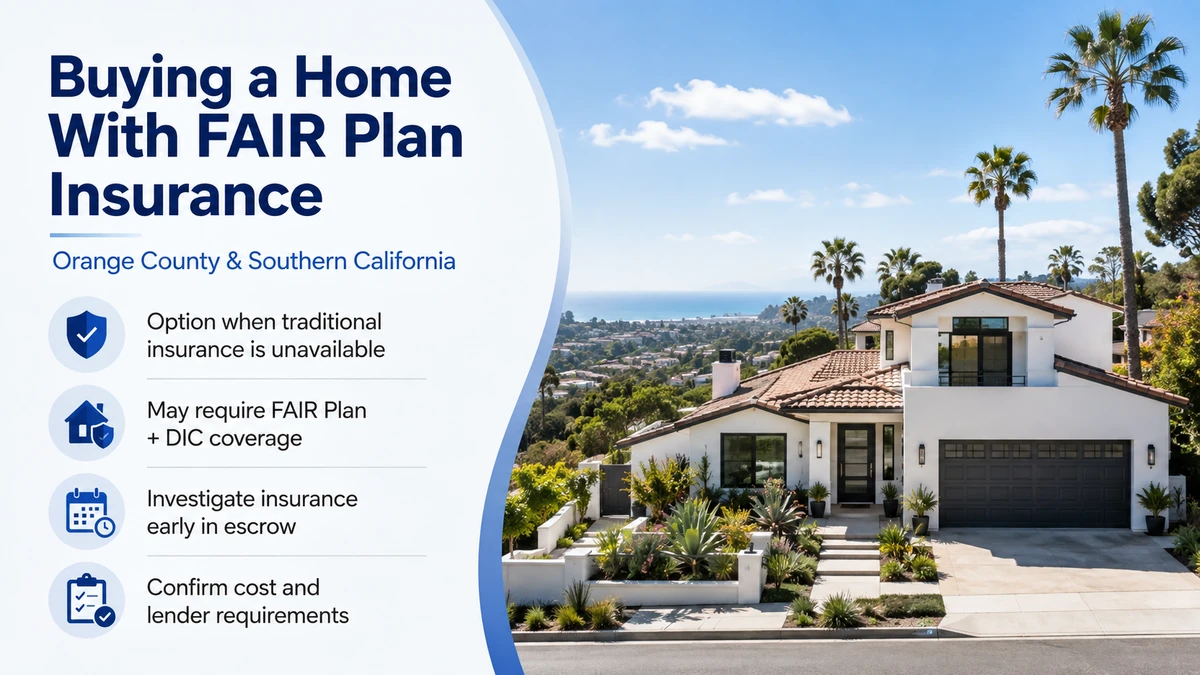
The California FAIR Plan provides basic property insurance when coverage is not reasonably available through the traditional insurance market.
It is commonly described as California's insurer of last resort.
The important distinction for buyers is that:
FAIR Plan coverage is not necessarily the same as a traditional homeowners policy.
Depending on the property and policy, a buyer may also need additional coverage, such as a Difference in Conditions (DIC) or companion policy.
The exact coverage, deductibles and exclusions should be reviewed with a qualified insurance professional.
Why Does FAIR Plan Insurance Matter During Escrow?
For a financed purchase, the lender will generally require acceptable property insurance before funding the loan.
A buyer can have:
- An accepted offer
- Completed inspections
- Reviewed disclosures
- Loan approval
- An appraisal
and still encounter a problem if acceptable insurance cannot be arranged.
That is why buyers should investigate insurance early when there is any reason to believe a property may be difficult to insure.
A Common Orange County Scenario
Consider a buyer purchasing a home near hills or open space.
The property appears well maintained. Nothing about the home itself immediately suggests a major problem.
But when the buyer begins looking for insurance, several traditional carriers will not accept the property.
An available option may instead be:
FAIR Plan + supplemental coverage
Now the buyer has a different decision to make.
The question is no longer simply:
Can this home be insured?
It becomes:
How much will the complete insurance package cost, what will it cover, and is this still the home I want to buy?
That is why FAIR Plan insurance becomes part of the real estate decision.
FAIR Plan Insurance Can Affect Affordability
Two homes selling for the same price can have very different ownership costs.
For example:
Home A
Traditional homeowners insurance:
$2,500 per year
Home B
FAIR Plan + supplemental coverage:
$7,000 per year
Difference:
$4,500 per year
or about:
$375 per month
Home B is not automatically a bad purchase.
Perhaps it has a larger lot, better view or location the buyer strongly prefers.
But the additional insurance expense should be included in the decision.
The buyer should look at:
Mortgage + Property Taxes + Insurance + HOA + Maintenance
not simply the purchase price.
Does the FAIR Plan Affect Your Mortgage?
Potentially.
Getting a FAIR Plan quote does not automatically mean the lender's insurance requirements have been satisfied.
Additional coverage may be necessary depending on the property and loan.
Buyers should confirm the proposed insurance with both:
- Their insurance professional
- Their lender
The earlier those conversations happen, the less likely insurance becomes a last-minute closing problem.
What Should Buyers Ask?
If a property may require FAIR Plan coverage, buyers should consider asking:
- Is traditional homeowners insurance actually unavailable?
- What will the FAIR Plan cost?
- Will I also need a DIC or companion policy?
- What is the combined annual cost?
- What major risks are and are not covered?
- Does the coverage satisfy my lender?
- Is the quote still subject to inspection or underwriting?
- Does the cost change whether I want to buy the property?
The goal is not simply to determine whether some form of insurance exists.
The goal is to understand what the home will actually cost to own.
Not Every Hillside Home Needs the FAIR Plan
Orange County and Southern California include many homes near hillsides, canyons and open space.
But location alone does not determine which insurance options will be available.
Insurers may also consider factors such as:
- Roof age
- Property condition
- Previous claims
- Rebuilding cost
- Vegetation
- Defensible space
- Individual underwriting standards
Buyers can review general wildfire information through CAL FIRE's Fire Hazard Severity Zone maps and information from the Orange County Fire Authority.
But a wildfire designation does not automatically mean the FAIR Plan is required.
An actual insurance quote for the specific property is more useful.
Is California's Insurance Market Improving?
There have been encouraging signs.
California is implementing its Sustainable Insurance Strategy, intended to increase insurance availability and reduce reliance on the FAIR Plan.
Even so, difficult-to-insure properties remain an issue in parts of Orange County and Southern California.
Buyers should continue to investigate the individual property rather than make assumptions based only on the neighborhood.
FAIR Plan Coverage Is One More Number to Evaluate
Buying a home with FAIR Plan insurance is not automatically a good decision or a bad one.
It is another part of the property's financial picture.
One buyer may decide a higher insurance expense is worth paying for a home with a great location, larger lot or exceptional view.
Another may decide the additional expense makes a competing property more attractive.
Neither decision is necessarily wrong.
The important thing is finding out while the buyer still has time to evaluate the property and available options.
At Legacy Real Estate, our role is to help buyers understand the real estate side of that decision while qualified insurance professionals determine the appropriate coverage.
You can also explore our Legacy Real Estate Insights and Orange County housing market research for more analysis affecting Orange County and Southern California homeowners.
Buying a home in Orange County or Southern California?

Legacy Real Estate does not provide insurance advice or insurance coverage. Insurance availability, pricing, underwriting and coverage vary by insurer and property. Buyers and property owners should consult a qualified insurance professional regarding insurance coverage and a qualified lender regarding financing requirements.