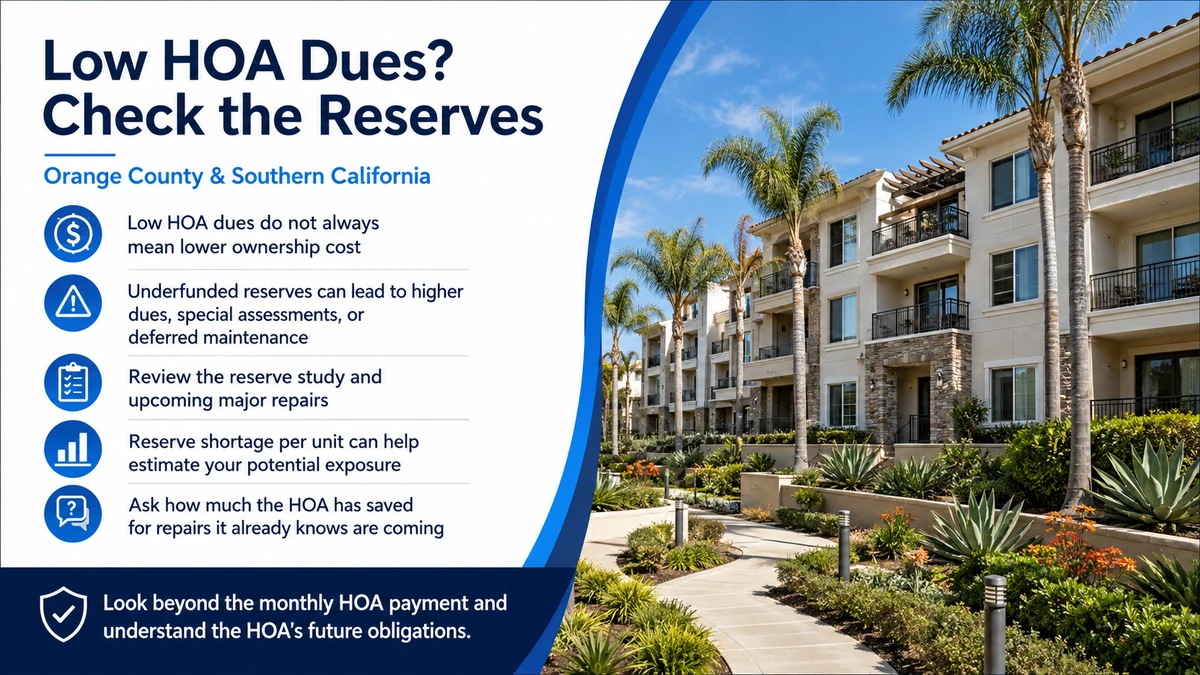
A condo with low HOA dues can look like a bargain.
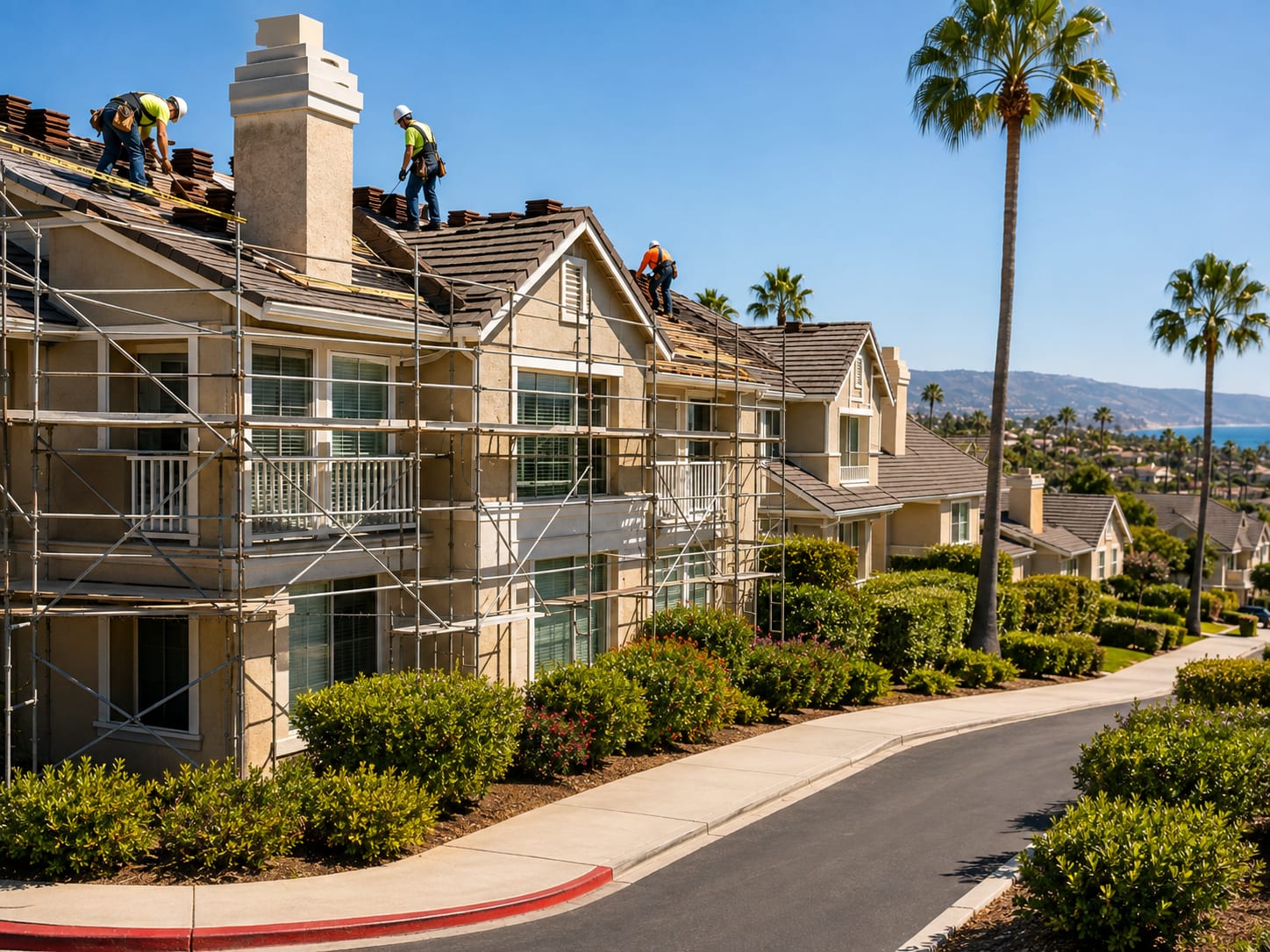
But the monthly payment does not tell you whether the association has enough money saved for the roof, exterior paint, streets or other major repairs that will eventually be needed.
If those reserves are too low, today's lower HOA payment can become tomorrow's higher dues, special assessment or HOA loan.
For condo buyers in Orange County and Southern California, that makes reserve funding an important part of understanding what a property may really cost to own.
What Are HOA Reserves?
HOA reserves are money set aside for large future repairs and replacements.
Depending on the community, reserves may eventually pay for things such as:
- Roof replacement
- Exterior painting and siding
- Streets and pavement
- Pools
- Common-area plumbing
- Building components
- Other major repairs
Many of these expenses are predictable.
An HOA may know years in advance that roofs are approaching the end of their expected life or that exterior painting will be needed.
The question is whether the association has been saving enough money along the way.
What Does It Mean When Reserves Are Underfunded?
An HOA is underfunded when it has less money set aside than its reserve plan estimates should be available for future obligations.
That does not automatically mean the association is in financial trouble.
Many HOAs are less than 100% funded and still have workable plans.
The bigger concern is when several things happen together:
Low reserves + major projects approaching + not enough money being contributed each year
At that point, the association may eventually have to collect more money from homeowners.
A $300,000 Shortage Can Look Different With Only 25 Units
Large HOA numbers can be difficult to put into perspective.
One simple way to understand the size of a reserve shortage is to divide it by the number of units.
We recently reviewed a smaller condominium association with approximately:
25 units
and an estimated reserve shortage of about:
$300,000
A rough calculation would be:
$300,000 ÷ 25 units = $12,000 per unit
That does not mean every homeowner will automatically receive a $12,000 special assessment.
The association might address the shortage over several years through higher dues, increased reserve contributions, borrowing, a special assessment or some combination of those options.
But the calculation helps a buyer understand the scale of the issue.
A $300,000 shortage sounds like an HOA problem.
$12,000 per unit makes it feel much more like an owner problem.
Low HOA Dues Can Be Misleading
Consider two similar Orange County condo communities.
Community A
Monthly HOA dues:
$500
The association consistently contributes to reserves and is preparing for future roof, exterior and other major projects.
Community B
Monthly HOA dues:
$350
At first, Community B looks cheaper.
The difference is:
$150 per month
or:
$1,800 per year
But suppose Community B has significantly underfunded reserves and a large roof project approaching.
If owners later receive a $10,000 special assessment, several years of lower monthly dues can disappear quickly.
That does not mean higher HOA dues are always better.
It means the amount of the dues should be viewed together with what the HOA is responsible for and how well it is funding those responsibilities.
What Happens When the Big Repair Finally Arrives?
Reserve shortages usually become most important when an expensive project can no longer be delayed.
Imagine an HOA needs:
$1 million for roof replacement
but has only:
$400,000 available
The remaining:
$600,000
still has to come from somewhere.
The association may increase monthly dues and direct more money toward the project.
It may levy a special assessment.
It could borrow money and repay the loan through future homeowner assessments.
Or the HOA may delay the work.
Sometimes postponing a project buys time. But deferred maintenance can also create larger and more expensive problems later.
The repair does not disappear simply because the reserve account does not have enough money.
What We've Seen in Orange County HOA Documents
Reserve funding can vary dramatically from one association to another.
In Orange County HOA documents we have reviewed, we have seen funding levels ranging from approximately 14% funded to approximately 95% funded.
Those percentages should not be treated as automatic pass-or-fail grades.
An HOA that is 14% funded does not automatically have a special assessment coming.
But a low funding level deserves closer attention when expensive projects are approaching.
An association around 95% funded generally has substantially more money set aside relative to its projected reserve obligations. That may give the HOA greater financial flexibility when major repairs are needed.
The more useful question is not simply:
What percentage funded is the HOA?
It is:
How much has the HOA saved compared with what it expects to spend, and what is its plan for closing any gap?
For a broader look at budgets, reserves, delinquencies and meeting minutes, see How to Review HOA Financials Before Buying a Condo in Orange County.
Can Underfunded Reserves Affect Condo Values?
Potentially.
Consider two similar condos.
One is in an HOA with strong reserves and no major financial issues on the horizon.
The other has low reserves, a roof replacement approaching and board discussions about raising dues or collecting a special assessment.
Some buyers may prefer the first condo because there is less financial uncertainty.
Others may still buy the second property, but the potential future expense may affect what they are willing to pay.
There is no simple formula saying a reserve shortage reduces a condo's value by a certain amount.
But buyers care about future ownership costs, and those expectations can influence demand.
Put the Shortage on a Per-Unit Basis
Another example:
Suppose an HOA has a reserve shortage of:
$500,000
and the community contains:
40 units
A rough calculation is:
$500,000 ÷ 40 = $12,500 per unit
Again, this is not a prediction that each owner will receive a $12,500 bill.
Assessment obligations may not be equal in every community, the shortage may be corrected over many years, and the HOA may use several funding methods.
But it is a useful way to turn a large association-level number into something a buyer can understand.
Underfunded Does Not Automatically Mean Don't Buy
An underfunded HOA can still be a reasonable place to buy.
The association may already have a realistic plan to improve its finances through:
- Gradual HOA increases
- Larger annual reserve contributions
- Planned special assessments
- Better long-term budgeting
- Recently completed major repairs
The more concerning situation is:
Low reserves + major expenses approaching + no clear plan to pay for them
That combination deserves more investigation.
The buyer should also consider the price of the condo itself. A property priced appropriately for the financial risk may still make sense.
Insurance Can Put More Pressure on Underfunded HOAs
Insurance is another expense that can complicate an already tight HOA budget.
If an association is underfunded and its master insurance premium rises sharply, the HOA may have even less room to increase reserve contributions.
That can lead to difficult choices between:
raising dues, reducing other expenses or delaying reserve funding.
For more on this issue, see Condo Insurance vs. HOA Master Insurance in Orange County: What Buyers Should Know.
Insurance and reserve funding should not be viewed as completely separate issues. They are both competing for the same HOA dollars.
The Monthly HOA Payment Is Only Part of the Cost
When comparing condos, buyers naturally focus on the current HOA dues.
But the actual ownership cost can include:
Mortgage + Property Taxes + HOA Dues + Insurance + Special Assessments + Maintenance
A condo with a $350 monthly HOA payment is not automatically less expensive than one with $500 dues.
The lower-cost community may simply be collecting less money today while leaving more obligations for future owners.
The goal is not to find the lowest HOA payment.
It is to understand what the association is responsible for, how much it has saved and how it plans to pay for what comes next.
Look at the Bill That Hasn't Arrived Yet
The difficult thing about underfunded reserves is that the cost often does not show up when you tour the condo.
You see the purchase price.
You see the current monthly HOA dues.
You do not necessarily see the roof replacement scheduled five years from now or the reserve shortage sitting in a 100-page HOA package.
That is why reserve funding deserves attention during escrow.
You are not only buying the unit.
You are also buying into your share of the association's future financial obligations.
For additional Orange County housing and ownership analysis, visit Legacy Real Estate Insights.
Buying a condo? A low HOA payment can look attractive today. Make sure you understand what the association may need from owners tomorrow.

Legacy Real Estate does not provide legal, accounting or financial advice.