

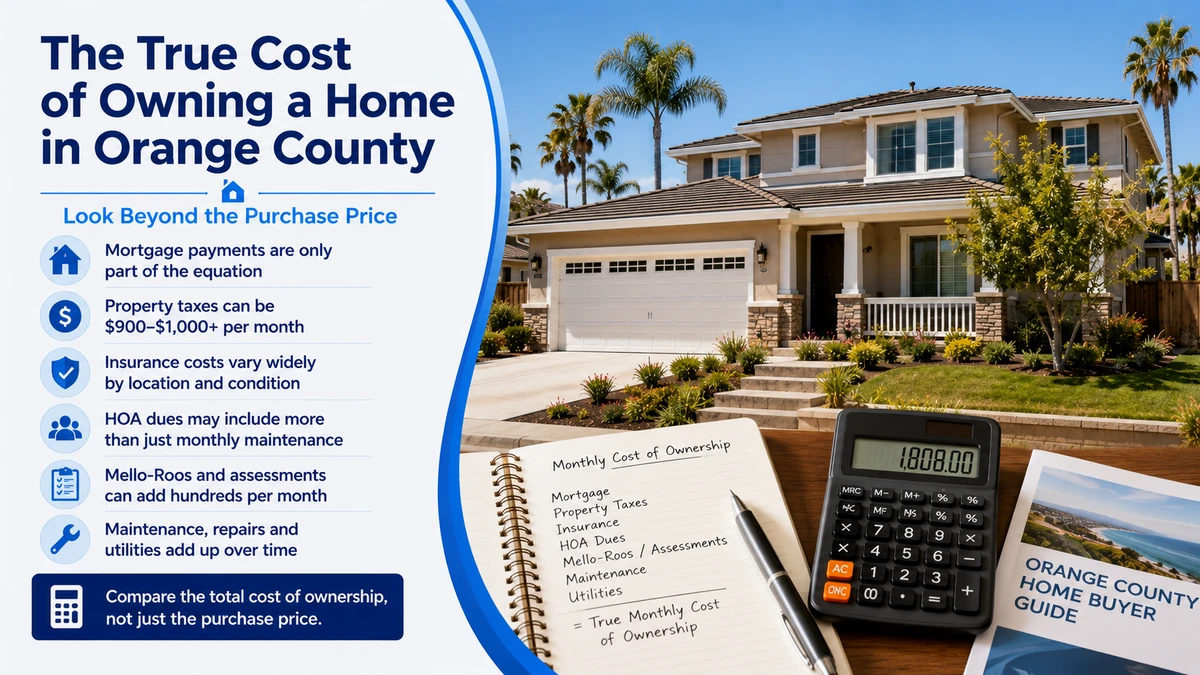
Two homes can sell for the exact same price and still have very different costs after closing.
One may have no HOA or Mello-Roos but need a roof, windows and remodeling.
Another may be newer and require very little work, but come with $500 or $600 monthly HOA dues plus additional assessments.
Then there are insurance, property taxes, landscaping, pools and repairs that do not appear in the listing price.
This is why the purchase price tells only part of the story.
When comparing homes in Orange County, a better question is:
What will this particular property actually cost me to own?
Think About Costs in Three Categories
It helps to separate homeownership expenses into three groups.
Costs Around the Purchase
These may include:
- Down payment
- Closing costs
- Prepaid taxes or insurance
- Immediate repairs
- Improvements you plan to make shortly after closing
Recurring Costs
These can include:
- Mortgage payment
- Property taxes
- Homeowners insurance
- HOA dues
- Mello-Roos or other assessments
- Utilities
- Landscaping or pool service
Irregular Costs
These are easy to overlook because they do not arrive every month:
- Roof replacement
- HVAC replacement
- Water heaters
- Plumbing
- Electrical work
- Windows
- Exterior painting
- Appliances
- Pool equipment
A realistic home-buying budget should consider all three.
For a broader overview of the buying process, see Buying a Home in Orange County: What Buyers Should Know.
The Mortgage Is Only the Starting Point
For most buyers, the mortgage is the largest monthly expense.
Your payment depends on the purchase price, down payment, interest rate, loan program and other financing terms.
But qualifying for a $1 million purchase does not mean every $1 million home fits the same budget.
The individual property determines many of the expenses that come next.
Property Taxes and Mello-Roos Can Change the Monthly Cost
California property taxes are generally based on assessed value, and a purchase will commonly result in a new assessed value under California's property-tax rules.
Buyers should not assume that the seller's current property-tax bill will become their tax bill.
The California State Board of Equalization explains how a change in ownership can affect assessed value.
Some properties also have Mello-Roos or other special assessments.
This can be particularly important when comparing an older neighborhood with a newer planned community.
In newer Orange County communities we have reviewed, Mello-Roos can add hundreds of dollars per month to the cost of owning the property.
The exact amount varies significantly.
This is why buyers should review the actual tax information for the property rather than relying on a generic percentage.
HOA Dues Are More Complicated Than They Look
Monthly HOA dues are one of the easiest costs for buyers to compare.
But the lowest HOA payment is not automatically the best value.
We've seen buyers react strongly to a difference such as:
HOA A: $400 per month
versus
HOA B: $600 per month
We have even seen a $200 monthly HOA difference affect how buyers valued a property by roughly $20,000.
Purely from the monthly arithmetic, it takes many years for that $200 difference to add up to $20,000.
But buyers may be reacting to more than the current payment.
A higher HOA can raise questions such as:
Why are the dues higher?
Are they likely to keep increasing?
Is the association financially stressed?
On the other hand, higher dues may simply mean the association is collecting enough money to properly maintain the property, fund reserves and pay for insurance.
A buyer should understand:
- What the HOA maintains
- What services are included
- How well reserves are funded
- Whether major repairs are approaching
- Whether insurance costs are increasing
- Whether special assessments are possible
Our guide to reviewing HOA financials before buying a condo goes deeper into this issue.
Homeowners Insurance Is a Real Ownership Cost
Insurance can also make two similarly priced properties very different financially.
Pricing and availability may vary based on:
- Wildfire exposure
- Location
- Roof
- Property condition
- Previous claims
- Rebuilding cost
- Individual insurer guidelines
The important point is not to assume the insurance premium on one home will resemble another.
Get a quote for the actual property during the transaction.
This can be especially important for homes near hillsides, canyons or open space.
For more on this issue, see How California Home Insurance Is Affecting Home Sales.
Maintenance Is the Cost Buyers Most Often Underestimate
In our experience, maintenance and repairs are one of the easiest costs for buyers to underestimate.
Construction costs have increased substantially.
In the projects and estimates we see today, updating a smaller Orange County home built in the 1960s through 1980s can easily become a major expense.
As a rough example:
Kitchen + bathrooms + flooring + interior paint: around $90,000
A more complete update to a smaller older home can approach:
$150,000
Those are not universal remodeling prices.
The cost depends on the property, materials, contractor and scope of work.
But they illustrate why a home that looks only somewhat dated can require much more money than a buyer expects.
Roofs and Windows Get a Lot of Buyer Attention
Two items we increasingly see buyers pay attention to are roofs and windows.
For recent projects and estimates we have worked with, a typical composition roof might be around:
$15,000 for a smaller single-story home
and closer to:
$25,000 for a two-story home
depending on size, access and condition.
Replacing older windows with double-pane vinyl windows can also add up quickly.
We've seen rough costs around:
$500 per window
and approximately:
$1,000 for a sliding door
including labor and materials, depending on the project.
A small house may have 10 to 14 windows.
A larger property may have 25 or more.
None of those items appear in your mortgage payment, but they can have a major effect on the first few years of ownership.
When inspections identify significant repairs, it also helps to understand whether to ask the seller for repairs, a credit, or another solution.
Pools Deserve Their Own Cost Calculation
A pool can be a major lifestyle feature.
It can also be expensive.
We recently dealt with a property where permanently filling in the pool cost about:
$12,000
The alternative quote to replaster the pool and deal with pump-related work was just under:
$50,000.
Then there are ongoing expenses such as:
- Pool service
- Chemicals
- Water
- Electricity
- Pumps and equipment
- Future resurfacing and repairs
Whether a pool is worth those costs is personal.
But buyers should think realistically about how often they will use it, rather than valuing the pool only as a feature when touring the house.
A Two-Home Orange County Comparison
Here is a simple hypothetical comparison using costs similar to what we see locally.
Assume both homes cost $1 million and, for simplicity, have similar mortgage terms, base property taxes, insurance and utilities.
Home A: Older Detached Home
- Purchase price: $1,000,000
- HOA: $0
- Mello-Roos: $0
- Interior updating needed: approximately $90,000
- Roof approaching replacement: approximately $15,000
Potential near-term work:
About $105,000
Home B: Newer Planned Community
- Purchase price: $1,000,000
- HOA: $550 per month
- Mello-Roos: $300 per month
- Significant immediate repairs: minimal in this example
Additional recurring cost:
$850 per month
or:
$10,200 per year
Which home is cheaper?
There is no automatic answer.
Home A could require more than $100,000 shortly after purchase.
Home B could cost more than $10,000 extra every year because of HOA dues and Mello-Roos.
Over roughly a decade, those recurring charges can become comparable to a major renovation budget, even before considering future increases, financing costs or resale.
The point is not that one home is better.
It is that:
Two $1 million homes are not financially interchangeable.
Older and Newer Homes Trade Different Costs
Older Orange County homes may have:
- No HOA
- No Mello-Roos
- Larger lots
- Established neighborhoods
but may also need:
- Roofs
- Windows
- HVAC
- Plumbing
- Electrical work
- Remodeling
Newer homes may offer:
- Newer systems
- Less immediate maintenance
- Modern layouts
- Community amenities
but can also come with:
- HOA dues
- Mello-Roos
- Smaller lots
- Higher recurring community costs
One thing we tell buyers is that new homes eventually become old homes.
The features that cannot easily be changed still matter.
Location, lot, yard, street, traffic and road noise should stand on their own after the newness wears off.
Do Not Use a Simple Maintenance Percentage for Every House
You will sometimes hear buyers told to budget a certain percentage of the home's value every year for maintenance.
That can be a useful reminder that maintenance exists, but it is not a very good way to compare two actual properties.
A $1 million recently renovated condo and a $1 million 1960s house with an older roof, pool and large yard do not have the same maintenance profile.
Look at the actual components.
Ask:
What is already old?
What has recently been replaced?
What will probably need money in the next five years?
What does the HOA maintain?
That creates a much more useful estimate.
A Better Way to Compare Two Homes
Before deciding which property is more affordable, compare:
- Purchase price
- Mortgage payment
- Property taxes
- HOA dues
- Mello-Roos or other assessments
- Homeowners insurance
- Immediate repairs
- Likely major repairs over the next several years
- Landscaping, pool and other maintenance
- What the HOA pays for versus what you pay directly
You do not need to predict every dollar you will ever spend.
That is impossible.
The goal is to avoid comparing two homes using only the numbers that appear on the listing.
The Cheapest House Is Not Always the Cheapest to Own
A property with lower monthly costs may require much more cash for repairs.
A newer home with very little maintenance may carry HOA dues and special taxes for years.
A condo with high dues may include exterior maintenance and insurance that a detached homeowner would otherwise pay directly.
Every property has a different combination.
At Legacy Real Estate, we try to help buyers look at that entire package:
What does it cost to buy?
What will it cost every month?
What expenses are likely to come later?
And are the property's benefits worth those costs?
For additional Orange County housing market data, trends and real estate analysis, visit Legacy Real Estate Insights.
The purchase price tells you what it costs to buy the home. The real comparison is what it may cost you to own it.

Legacy Real Estate does not provide legal, tax, insurance or financial advice.