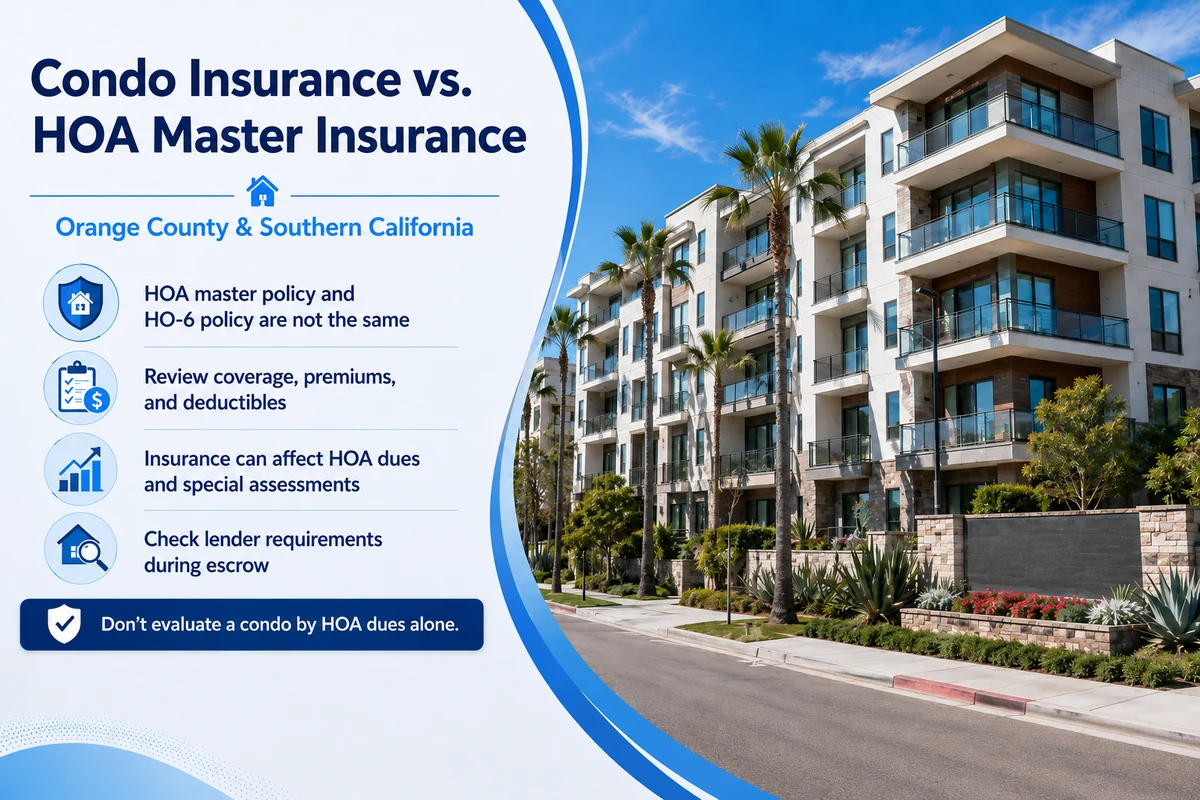
When you buy a condo, you are not only buying the unit.
You are also buying into a homeowners association that maintains its own insurance policy.
That creates two layers of insurance:
The HOA's master insurance policy
and
The owner's individual condo policy, usually called an HO-6 policy.
Understanding where one policy ends and the other begins is important.
In Orange County and Southern California, rising insurance costs can also affect HOA dues, deductibles, financing and even future special assessments.
What Does the HOA Master Insurance Policy Cover?
The homeowners association generally carries a master insurance policy for certain portions of the condominium development.
Depending on the community and policy, coverage may include:
- Building structures
- Roofs
- Exterior walls
- Common areas
- Pools and clubhouses
- Certain building components
- HOA liability
But there is no single rule that applies to every condo community.
The HOA's governing documents and insurance policy help determine what the association is responsible for and what belongs to the individual owner.
That is why buyers should not assume:
“The HOA insures the building, so everything is covered.”
The actual policy matters.
What Is HO-6 Condo Insurance?
An HO-6 policy is the individual condo owner's insurance policy.
Depending on the coverage selected, it may protect things such as:
- Personal belongings
- Interior improvements
- Personal liability
- Loss of use
- Certain interior portions of the unit
- Loss assessments
What the owner needs can depend partly on what the HOA's master policy already covers.
The two policies should work together without leaving important gaps.
A qualified insurance professional should review the HOA's coverage when helping a buyer determine what individual coverage is appropriate.
Why Should Buyers Review HOA Insurance During Escrow?
HOA insurance is not just an insurance issue.
It is also a financial issue for the community.
During escrow, condo buyers commonly receive HOA documents such as:
- Budgets
- Reserve studies
- Financial statements
- Meeting minutes
- CC&Rs
- Rules
- Insurance information
These documents help show how the association is operating.
If the HOA's insurance premium has increased significantly, that money has to come from somewhere.
The association may eventually respond by:
- Raising HOA dues
- Increasing deductibles
- Cutting other expenses
- Changing coverage
- Using available operating funds
- Levying a special assessment
An insurance problem at the HOA level can therefore become a homeowner expense.
A Simple Orange County Condo Example
Consider two similar condos selling for $650,000.
Condo A
The HOA has relatively stable insurance costs.
Monthly HOA dues:
$425
Condo B
The HOA recently experienced a large increase in its master insurance premium.
Monthly HOA dues were increased to:
$550
Difference:
$125 per month
or:
$1,500 per year
The condos may have similar purchase prices, but their ownership costs are different.
And the current dues only tell part of the story.
If insurance expenses continue increasing, the association may face additional pressure on its budget.
That is why buyers should look beyond the monthly HOA number and ask:
Why are the dues what they are, and what expenses is the HOA facing?
The Master Policy Deductible Matters
The premium is not the only number worth reviewing.
The HOA's insurance deductible can also be important.
Some master policies carry large deductibles, especially for certain types of claims.
A buyer should try to understand:
- What deductibles apply
- When an owner could become responsible for part of a deductible
- Whether the HO-6 policy can provide related coverage
- Whether the HOA can assess owners for certain losses
A large deductible does not automatically mean the association has poor insurance.
But it can increase the owner's financial exposure after a loss.
Can HOA Insurance Affect Your Mortgage?
Yes.
With a condominium purchase, the lender may evaluate more than the individual buyer.
The condominium project itself may also have to satisfy certain loan requirements.
Insurance can be part of that review.
If the HOA's master policy does not meet the lender's requirements, financing can become more difficult even if the buyer otherwise qualifies for the mortgage.
This is another reason to review HOA insurance early rather than discovering a problem shortly before closing.
Rising Insurance Costs Can Affect HOA Finances
Insurance has become a larger expense for some California homeowners associations.
When a master-policy premium rises substantially, the HOA has limited ways to absorb the cost.
It can collect more money or spend less somewhere else.
That may mean:
Higher dues.
Or it may mean less money available for other operating expenses.
This is why a condo community with lower HOA dues is not automatically the better financial choice.
For example:
HOA A: $350 per month
HOA B: $500 per month
At first glance, HOA A looks less expensive.
But HOA B could be contributing more to reserves, paying for more exterior maintenance, providing additional utilities and maintaining stronger insurance coverage.
Meanwhile, HOA A could have low dues because it has not been collecting enough money.
The better question is:
Is the HOA collecting enough to properly insure, maintain and operate the community?
What Should Condo Buyers Review?
You do not need to become an insurance expert to buy a condo.
But there are several useful questions to ask during escrow:
- What does the HOA master policy cover?
- What deductibles does the association carry?
- Has the insurance premium increased significantly?
- Has the HOA recently changed insurance companies?
- Has the association been non-renewed?
- Has coverage been reduced?
- Does the master policy satisfy the lender?
- How is insurance affecting the HOA's budget?
- What should the buyer's HO-6 policy cover?
- Could owners face an assessment after certain losses?
Technical coverage questions should be reviewed with the appropriate insurance professionals.
From the real estate side, the important issue is understanding how the HOA's insurance affects the cost and risk of owning the condo.
Insurance Should Be Reviewed With the HOA's Financials
Looking at the master policy by itself does not give you the full picture.
Suppose an HOA has experienced a large insurance increase but also has:
- Strong reserves
- Reasonable operating cash
- Well-funded maintenance plans
- Dues that adequately cover expenses
That community may be able to absorb the higher expense more easily.
Another association may already have underfunded reserves and a tight operating budget.
The same insurance increase could create a much bigger problem there.
This is why HOA insurance should be reviewed together with the budget, reserves and other financial documents.
What Does Condo Ownership Really Cost?
The purchase price is only one part of buying a condominium.
The total cost can include:
Mortgage + Property Taxes + HO-6 Insurance + HOA Dues + Special Assessments + Maintenance
The HOA's master insurance can influence several of those expenses.
A well-run association with somewhat higher dues may sometimes be financially healthier than a community with unusually low dues and larger future obligations.
The goal is not to find the condo with the lowest HOA payment.
It is to understand what you are paying for and what financial risks may exist behind that number.
Two Insurance Policies, One Ownership Decision
The simplest way to think about condo insurance is that the HOA and the individual owner each have part of the responsibility.
The important question is whether those two pieces fit together.
For a condo buyer, that means looking at more than whether an HO-6 policy can be purchased.
It also means understanding the association's coverage, deductibles and financial ability to handle rising insurance costs.
That information can help a buyer make a better comparison between two otherwise similar condo communities.
For a broader look at the issue, read How California Home Insurance Is Affecting Home Sales.
You can also explore Legacy Real Estate Insights and Orange County housing market research for additional analysis of homeownership and real estate in Orange County and Southern California.
Buying a condo? Review the HOA's insurance and finances before deciding what the property is really worth to you.

Legacy Real Estate does not provide insurance, legal or financial advice.