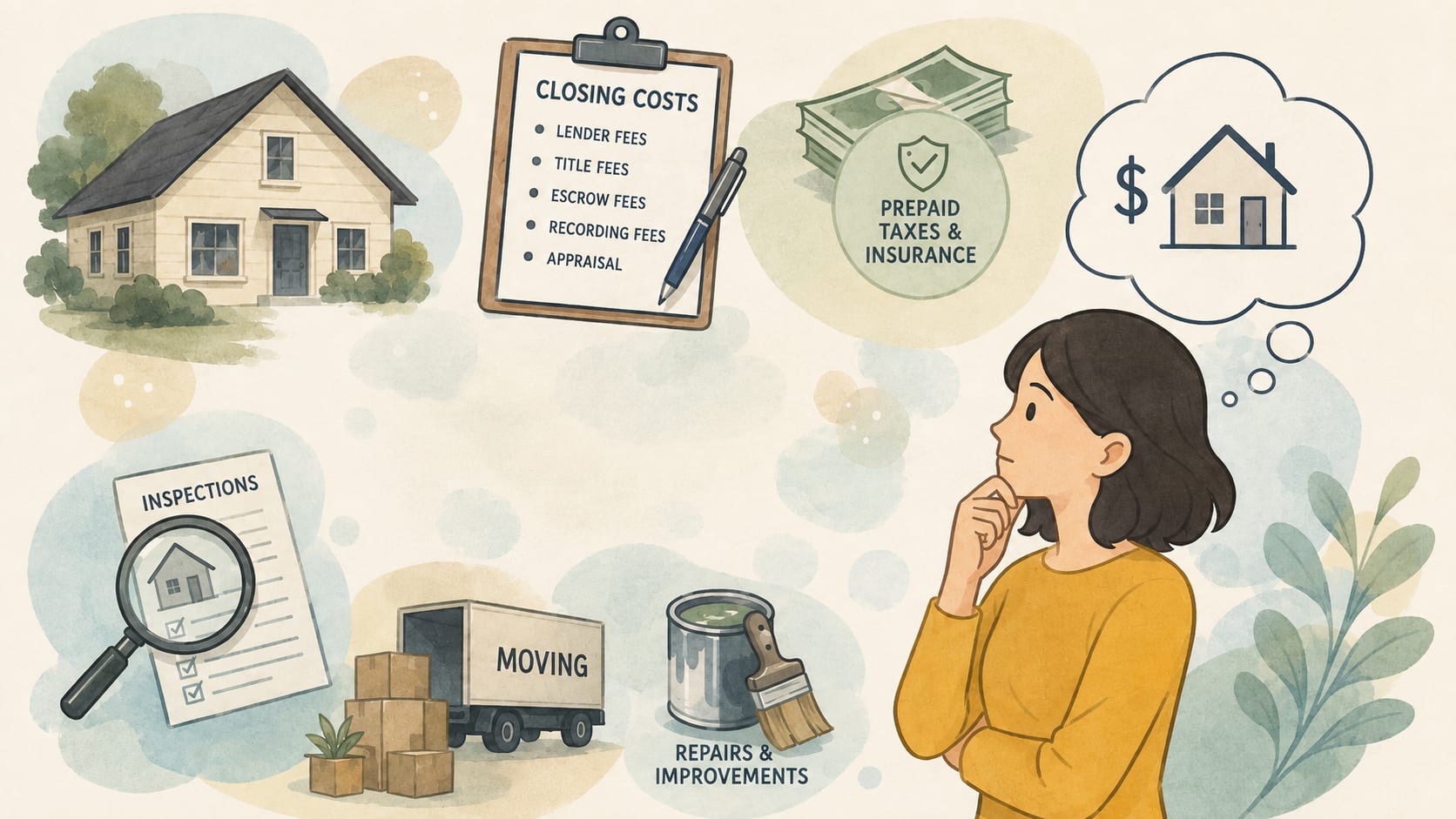

The cash you need to buy a home is more than just the down payment.
A buyer may need money for:
- Down payment
- Closing costs
- Prepaid taxes and insurance
- Inspections and other due diligence
- Appraisal
- Moving
- Immediate repairs
- Improvements
- Cash reserves after closing
That is why someone with $150,000 in savings does not necessarily have $150,000 available for a down payment.
The better question is:
How much cash will I need to complete the purchase comfortably, and how much do I want left after closing?
For a broader overview of financing, property condition, insurance, HOAs, and the buying process, see Buying a Home in Orange County: What Buyers Should Know.
Down Payment Is Not the Same as Cash to Close
Buyers often use these terms as though they mean the same thing.
They do not.
Your down payment is the portion of the purchase price you are paying rather than financing.
Your cash to close can include the down payment plus other amounts required to complete the transaction.
A simple way to think about it is:
Down payment + closing costs + prepaid expenses + other transaction costs = approximate cash needed to close
Then there is another number:
Cash you want remaining after closing
That last number is easy to overlook.
You Do Not Necessarily Need 20% Down
A 20% down payment is not a universal requirement.
Depending on the borrower, property, lender, and loan program, qualified buyers may have substantially lower down-payment options.
For example, current programs can include:
- Certain conventional loans with down payments as low as 3%
- FHA financing with a 3.5% minimum required investment in many cases
- VA financing that can allow eligible borrowers to purchase with no down payment in certain circumstances
That does not mean the lowest possible down payment is automatically the best choice.
A smaller down payment generally means borrowing more and can change:
- Monthly payment
- Interest costs
- Mortgage insurance
- Loan pricing
- Qualification
The lender should model the actual choices.
The important point is that buyers should not automatically wait until they have accumulated 20% without first finding out what financing options are actually available to them.
Closing Costs Require Additional Cash
Buying a home also involves costs associated with obtaining the loan and closing the transaction.
Depending on the property and financing, these may include:
- Lender fees
- Escrow charges
- Title-related charges
- Recording and government fees
- Appraisal
- Prepaid interest
- Other loan or closing expenses
The Consumer Financial Protection Bureau uses roughly 2% to 5% of the purchase price as an early planning range for closing costs, excluding the down payment.
That is a planning range, not an Orange County quote.
Actual costs can vary considerably based on the loan, lender, purchase price, property, location, and transaction.
Once you speak with a lender, replace the generic estimate with a loan-specific Loan Estimate.
Some Money May Be Prepaid for Taxes and Insurance
Part of the cash needed at closing may not feel like a traditional fee.
Depending on the loan, buyers may need money for items such as:
- Initial homeowners insurance premium
- Initial escrow or impound account funding
- Property-tax reserves
- Prepaid mortgage interest
Those amounts vary according to the property, lender, closing date, tax schedule, insurance premium, and loan structure.
This is another reason a rough down-payment calculation is not enough.
Some Expenses Arrive Before Closing Day
Buyers also need liquid cash available during escrow.
Depending on what you choose to investigate, you may pay for:
- General home inspection
- Appraisal
- Roof inspection
- Sewer inspection
- Plumbing evaluation
- Electrical evaluation
- Foundation or structural evaluation
- Pool inspection
- Pest inspection
- Other specialist reports
Not every property needs every inspection.
But the buyer should expect that some due-diligence expenses can arise before the final closing statement is prepared.
Repairs Are One of the Biggest Cash Surprises
In our experience, repairs are one of the costs buyers most often underestimate.
A buyer may have enough money to:
Make the down payment + pay closing costs
and still not have enough money to comfortably own the particular house they are buying.
Imagine closing and then discovering that the home needs substantial work involving:
- HVAC
- Roof
- Plumbing
- Electrical
- Flooring
- Appliances
- Pool equipment
- Paint or other immediate improvements
Some buyers intentionally choose a smaller down payment because they know they want cash available after closing.
We have seen buyers preserve money because they planned to:
- Repair the home
- Customize it
- Remodel
- Add living space
- Build an ADU
Putting every available dollar into the down payment could make the mortgage smaller but leave the buyer unable to complete the work they purchased the property intending to do.
There is a tradeoff between:
Reducing the loan
and
Maintaining liquidity.
A $900,000 Cash-to-Close Example
Here is a clearly hypothetical example to show how this works.
Assume a buyer is purchasing a home for:
$900,000
The buyer has:
$160,000 total available savings
Suppose the buyer is considering a 10% down payment.
Down payment
10% of $900,000:
$90,000
Estimated closing charges
For this hypothetical example, assume:
$18,000
This could include lender, escrow, title, recording, and other closing-related charges.
Estimated prepaid taxes, insurance, and impounds
Assume:
$9,000
Inspections and other due diligence
Assume:
$1,500
Moving and immediate repairs
Assume:
$7,500
Personal emergency reserve
Assume the buyer wants to retain at least:
$20,000
The complete planning calculation becomes:
| Cash Need | Amount |
|---|---|
| Down payment | $90,000 |
| Closing charges | $18,000 |
| Prepaids / impounds | $9,000 |
| Inspections / due diligence | $1,500 |
| Moving / immediate repairs | $7,500 |
| Personal reserve | $20,000 |
| Total planned cash | $146,000 |
With $160,000 available, the buyer would have approximately:
$14,000 of additional cushion
under these assumptions.
The numbers are hypothetical, not Orange County averages.
But the example illustrates the important point:
A buyer with $160,000 in savings does not necessarily have $160,000 available for the down payment.
What If That Buyer Put 15% Down?
A 15% down payment on the same $900,000 property would be:
$135,000
That is another $45,000 going into the house.
The buyer started with only $160,000.
Before even paying closing costs, inspections, moving expenses, or retaining an emergency fund, only:
$25,000
would remain.
The larger down payment might produce a better loan structure.
But it could also leave the buyer uncomfortably short on cash.
That is why the right question is not:
What is the largest down payment I can make?
It is:
Which down-payment strategy produces the combination of monthly payment and remaining cash that works for me?
A qualified lender should calculate both scenarios.
Keep a Personal Emergency Fund After Closing
We generally prefer buyers to think beyond the lender's minimum requirements and retain a meaningful personal reserve after purchasing.
A useful planning target can be around:
Six months of total household expenses
including:
- Housing payment
- Utilities
- Insurance
- HOA dues
- Services
- Transportation
- Food
- Other normal expenses
That is not a universal lending requirement.
It is a financial cushion.
For many households we work with, six months of expenses can easily mean at least $20,000.
The appropriate amount varies.
The reason for keeping it is simple.
An HVAC system can fail.
A plumbing problem can arise.
A car can need replacement.
Income can temporarily change.
A purchase that seemed affordable with $30,000 remaining in the bank can feel very different when the buyer closes with $2,000.
The goal should not merely be to make it through closing.
It should be to remain financially comfortable afterward.
Lenders May Have Their Own Reserve Requirements
Personal emergency savings and lender-required reserves are two different things.
Some lenders and loan scenarios require the buyer to demonstrate that certain assets will remain available after closing.
In transactions we see, lenders may sometimes want approximately two months of the complete housing expense, including:
- Principal
- Interest
- Property taxes
- Homeowners insurance
- HOA dues when applicable
This is sometimes described as two months of PITI + HOA reserves.
But it is important not to treat two months as a universal mortgage rule.
Reserve requirements vary by:
- Loan program
- Property type
- Occupancy
- Number of financed properties
- Underwriting result
- Lender overlays
- Borrower circumstances
For example, Fannie Mae's current guidelines do not impose a blanket two-month reserve requirement on every one-unit principal-residence purchase, while other transaction types can require two months, six months, or additional reserves.
Ask the lender specifically:
How much cash must I have to close, and how much must remain afterward for underwriting?
Then separately decide how much you personally want left.
Earnest Money Usually Comes From the Same Pool of Funds
The earnest money deposit can also confuse buyers.
The deposit is generally not simply another expense added on top of your down payment.
It is money deposited during the transaction that is ordinarily credited as part of the buyer's funds in the transaction at closing, subject to the purchase agreement and transaction.
But timing matters.
You need those funds available when the contract requires the deposit.
A buyer who has money tied up in another property, investment account, or transfer should know how quickly those funds can actually become available.
Seller Credits Can Reduce Cash Needed at Closing
A negotiated seller credit can sometimes reduce the buyer's allowable closing costs.
That can make a major difference for a buyer who has adequate income and financing but wants to preserve cash.
However, the credit is subject to:
- Lender requirements
- Loan-program rules
- Eligible costs
- Transaction structure
- The agreement with the seller
And buyers generally should not assume an unused portion of a seller credit simply becomes cash they can take home.
Know your estimated costs before negotiating the amount.
Our guide to Seller Credits vs. a Lower Purchase Price: Which Is Better for Buyers? explains the tradeoff in more detail.
What About Using Cash to Buy Down the Interest Rate?
Buyers may also have the option to use money toward discount points or certain allowable rate-buydown structures.
Whether that makes sense depends on the actual loan.
A buyer should compare:
- Upfront cost
- Monthly savings
- Expected time before selling or refinancing
- Cash reserves
- Alternative uses of the money
For a buyer planning significant work immediately after closing, keeping $10,000 available for the property might be more important than reducing the payment.
For another buyer, the rate reduction may be more useful.
Have the lender calculate both.
Property Type Can Change How Much Cash You Need
The property itself affects the answer.
Condo or Townhome
A buyer may need to consider:
- HOA dues
- Existing assessments
- Move-related fees
- Association requirements
- Future HOA obligations
The association's financial condition can also affect future ownership costs. Before buying, it is worth reviewing the HOA financials rather than looking only at the monthly dues.
Older Detached Home
An older home may have no HOA or special assessments but require more cash for:
- Roof
- HVAC
- Plumbing
- Electrical work
- Landscaping
- Remodeling
Newer Home
A newer property may need fewer immediate mechanical repairs but still require cash for things such as:
- Window coverings
- Landscaping
- Furniture
- HOA expenses
- Other setup or customization
The age or property type does not determine which home is better.
It changes where the money may go.
Insurance Can Affect Both Cash and Monthly Cost
Homeowners insurance should be investigated early rather than treated as a last-minute closing item.
The annual premium affects affordability.
The initial premium and escrow requirements can also affect cash needed to close.
And the actual cost can vary significantly between properties.
Our article on homeowners insurance during escrow in Orange County explains why getting property-specific information early can prevent surprises.
Cash Needed and Affordability Are Different Questions
A buyer can be in either of these situations:
I can afford the monthly payment but do not have enough cash to close comfortably.
or:
I have plenty of cash for the down payment, but I do not want the resulting monthly payment.
Those are different problems.
Cash-to-close determines whether you can complete the purchase with adequate liquidity.
Affordability determines whether the ongoing ownership costs fit comfortably within your finances.
And the property itself determines how much money you may need after closing.
For a broader look at those ongoing expenses, see The True Cost of Owning a Home in Orange County.
Before You Start Seriously Shopping, Do This Calculation
Start with:
Total liquid cash available
Then subtract:
- The personal emergency reserve you want to keep
- Estimated closing costs
- Estimated prepaid taxes and insurance
- Inspection and appraisal expenses
- Moving and setup expenses
- Immediate repairs or improvements you expect
What remains is a much better starting point for deciding how much cash is actually available for your down payment.
Then have a lender calculate several scenarios.
For example:
5% down
versus
10% down
versus
20% down
if those structures are available and appropriate for your financing.
Compare:
Cash required today + monthly payment + cash remaining afterward
rather than concentrating on only one of those numbers.
Legacy Real Estate Insights
For more Southern California housing-market data, trends, ownership-cost information, and practical real estate analysis, visit Legacy Real Estate Insights.
Purchase price is only one part of getting financially prepared to buy. Insurance, property condition, interest rates, HOA costs, taxes, and repair expenses can all change how much cash a particular property requires.
Still Figuring Out How Much You Need to Save?
You do not have to wait until you find a house to start working through the numbers.
Legacy Real Estate can help Orange County buyers think through:
- Different property types
- Likely ownership expenses
- HOA and assessment considerations
- Property condition
- Potential repairs
- How much money may be needed during escrow
- How much cash they may want to preserve afterward
A lender can then calculate the financing options and actual cash-to-close requirements.
Before putting every available dollar toward a down payment, it helps to understand what else that money may need to do after you own the house.

Legacy Real Estate does not provide mortgage, tax, investment, insurance, or financial advice.