
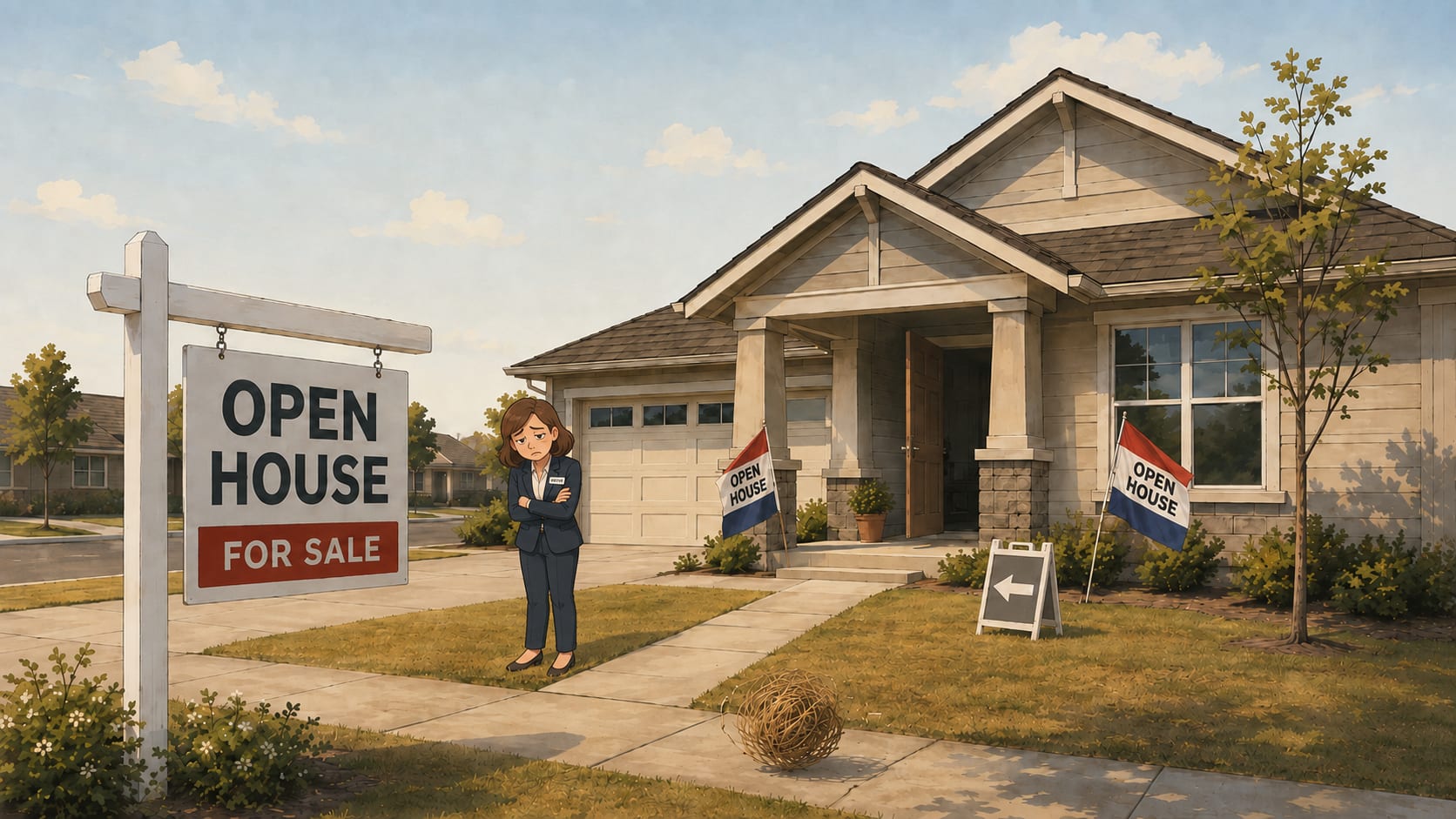
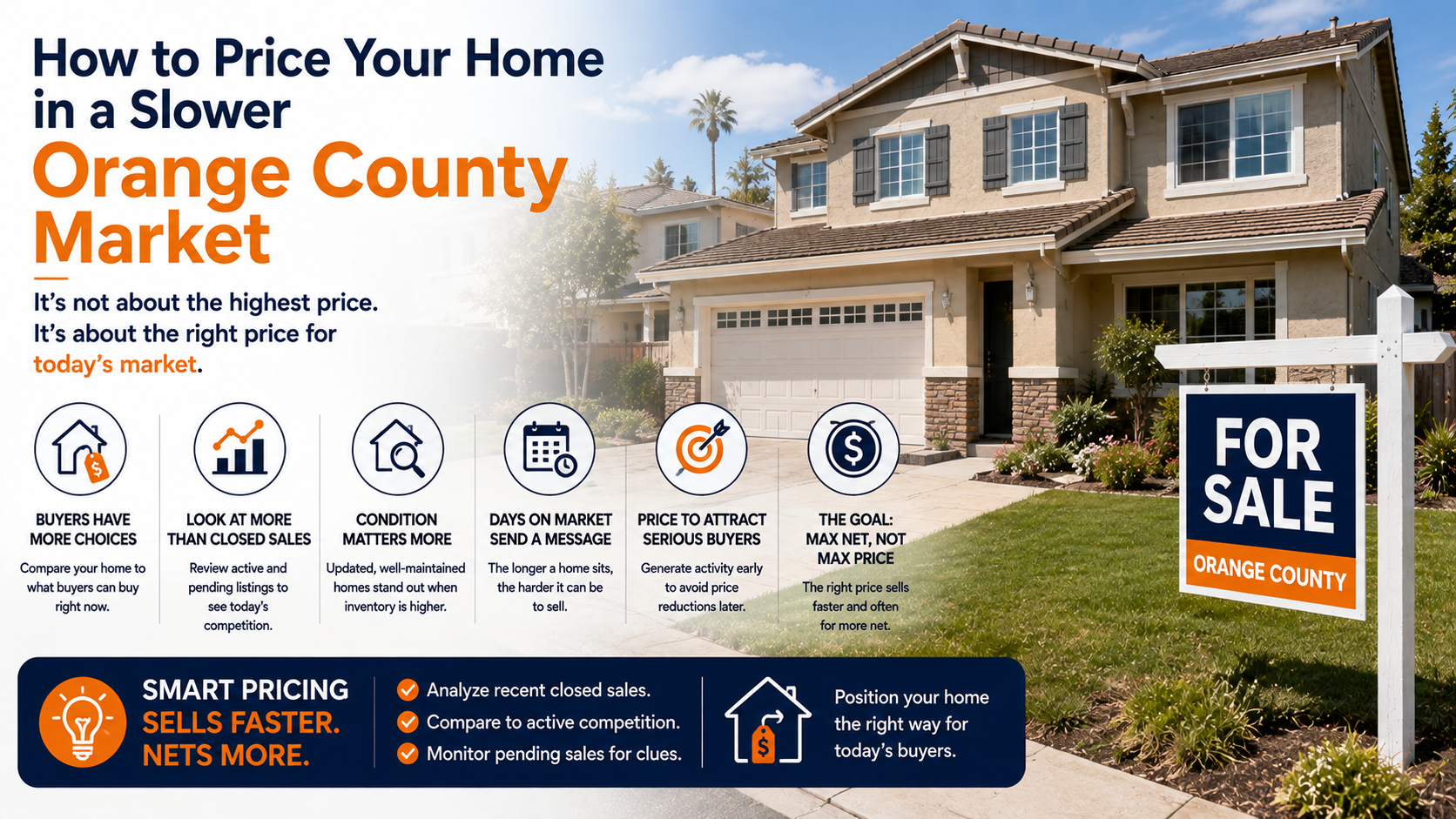
When an Orange County market segment slows down, pricing becomes less about testing the highest number a seller might possibly get and more about positioning the property against the choices buyers have today.
Recent comparable sales still matter.
But sellers also need to understand:
- What buyers can purchase right now
- How their home's condition compares
- Whether competing homes are going pending
- How much activity their listing receives
- Whether current demand is strengthening or weakening
- How much time they have to sell
That does not automatically mean pricing low.
It means the list price should make sense relative to the current market, not merely a seller's desired number.
For a broader overview of preparation, pricing, negotiations, and the selling process, see Selling a Home in Orange County: What Sellers Should Know.
Is Orange County Actually in a Slower Market Right Now?
As of July 2026, Orange County is better described as a mixed market than a uniformly slow one.
California Association of REALTORS® data for existing Orange County single-family homes showed:
- Median sale price: $1,475,000
- Up 5.4% from July 2025
- Unsold inventory: 3.1 months
- Up from 2.8 months in June
- Median time on market: 26 days
- Compared with 28 days in July 2025
So countywide single-family inventory increased from the prior month, but remained below the 3.3 months recorded one year earlier. Prices were also higher year over year.
Redfin's broader Orange County data, which includes all property types, showed a somewhat different picture in June 2026: a 40-day median market time, 99.4% sale-to-list ratio, and price reductions on approximately 19% of listings.
That is why sellers should be careful with countywide labels.
An entry-level Anaheim condo, a detached Brea home, an Anaheim Hills property, and a luxury Yorba Linda home can behave very differently at the same time.
The question is not simply:
Is Orange County slow?
It is:
How much competition and buyer demand exist for my particular property right now?
Closed Sales Tell You What Buyers Paid
Recent comparable sales are still the foundation of most pricing analyses.
They provide evidence of what buyers actually agreed to pay for similar properties.
Good comparable sales should be evaluated for meaningful differences such as:
- Location
- Square footage
- Lot
- Condition
- Floor plan
- View
- HOA
- Parking
- Age
- Upgrades
- Property type
But closed sales have one limitation in a changing market.
They are historical.
A property closing today may have gone into escrow several weeks earlier, when buyers had different alternatives or market conditions were different.
That becomes increasingly important when market momentum is changing.
Active Listings Tell You What Buyers Can Choose Today
We put relatively little weight on the asking prices of active listings as evidence of value.
A seller can ask anything.
A home listed for $1.2 million does not prove that another home is worth $1.2 million.
But active listings are extremely important for a different reason:
They show your competition and can help identify the pricing ceiling.
Suppose recent comparable sales suggest your house is worth approximately $1 million.
But buyers currently have three similar homes available:
- One at $975,000 in similar condition
- One at $999,000 with a remodeled kitchen
- One at $1.025 million with a larger lot
Trying to list yours at $1.075 million becomes difficult to justify simply because a house sold for $1.05 million three months ago.
Your buyer is looking at today's choices.
Pending Sales Can Tell You Where Buyers Are Acting
Pending properties can provide another clue.
If several similar listings have recently gone pending while yours remains available, that tells you where buyers are directing their attention.
The limitation is that the final terms usually are not known until closing.
The pending property may have:
- Sold above asking
- Sold below asking
- Included seller credits
- Received unusually strong terms
- Been negotiated after inspections
So pending sales are signals, not completed comparable sales.
But in a slower or changing market, those signals can be useful because they reflect more current buyer behavior than a sale negotiated months ago.
Buyers Compare Your Home With Its Alternatives
A seller may reasonably say:
"A similar home sold for $1.05 million."
The buyer may respond:
"But I can buy this other house for $999,000."
Both can be relevant.
Buyers compare:
Price + Condition + Location + Features + Ongoing Costs
They do not evaluate your home in isolation.
This is why property condition can become more important when buyers have more choices.
When inventory is extremely limited, buyers may tolerate dated flooring, an older HVAC system, or deferred maintenance because there are few alternatives.
When more homes are available, the updated property down the street becomes much harder to ignore.
A seller generally has several choices:
- Improve the property.
- Price its existing condition appropriately.
- Accept that a narrower buyer pool may require more time.
Why "Leaving Room to Negotiate" Can Backfire
One of the most common pricing strategies sounds reasonable:
"We want $1 million, so let's list at $1.075 million and leave room to negotiate."
The problem is that the buyer first has to become interested enough to negotiate.
A buyer cannot negotiate with a property they never seriously consider.
If competing homes appear to offer better value, an overpriced listing may generate:
- Fewer inquiries
- Fewer showings
- Less open-house traffic
- Fewer offers
- More market time
The seller eventually may reduce the price anyway.
By then, the property is no longer a new listing.
That does not mean every seller needs to list at the lowest possible number.
It means the additional negotiating room has a cost if it pushes the property outside the range where buyers perceive value.
A Real Example of Starting Too High
We had a listing where we believed an appropriate initial price was around:
$850,000
The property instead started at:
$940,000
After approximately two weeks, it was reduced to:
$925,000
Two escrows subsequently fell through.
The price eventually moved to:
$899,000
and later:
$850,000
By that point, even $850,000 generated little immediate interest.
The vacant property had accumulated substantial market time.
It eventually sold for approximately:
$817,000
after nearly six months.
In our assessment, launching near $850,000 initially likely would have given the property a much better chance of selling quickly.
We cannot know with certainty what a buyer would have paid under a different strategy.
But the transaction illustrates an important slower-market risk:
An unrealistic initial price can cost momentum, and reducing to the appropriate range later does not necessarily recreate the conditions that existed when the listing was new.
The First Price Matters, but It Is Not Irreversible
You do not literally get only one chance to price a house.
Prices can be adjusted.
But initial pricing determines how the property enters the market.
New listings tend to receive concentrated attention from:
- Buyers already watching the area
- Agents with active clients
- Listing alerts
- Search portals
- Buyers who have been waiting for something similar
If the property appears substantially overpriced during that initial exposure, some of those buyers may move on.
A later adjustment can bring them back.
But it may not recreate all of the original momentum.
Search Price Ranges Matter
Buyers commonly establish maximum and minimum prices when searching for homes.
That means the difference between:
$999,000
and
$1,025,000
can affect which buyers see a property depending on the search ranges they choose.
There is no universal portal algorithm that makes one threshold automatically correct.
The practical point is simply that list price affects both:
How buyers perceive the value
and
which searches the home fits into.
That should be considered when choosing or adjusting the price.
Do Not Automatically Underprice the Home Either
Pricing low is not universally better.
Some strategies intentionally price below expected market value in hopes of generating multiple offers.
That can work in the right circumstances.
But it can also fail.
If the anticipated bidding competition does not materialize, the seller may simply receive offers near the lower asking price.
An unusual property with few comparable sales can make an intentionally low strategy even harder to predict.
The pricing strategy should match:
- Buyer demand
- Property type
- Competition
- Seller objectives
- Likelihood of multiple offers
The objective is competitive positioning, not automatically choosing the lowest possible asking price.
What You Spent Does Not Determine What the Home Is Worth
Another common seller argument is:
"I put $100,000 into the property, so I need to get that $100,000 back."
Buyers do not calculate value that way.
Improvements can absolutely increase value and marketability.
But the market decides how much buyers are willing to pay for them.
We have worked with a property investor who bought a home that ultimately needed more work than anticipated. After completing the project, there was very little profit left.
The investor was also renovating another property and wanted to increase the desired sale price by approximately $120,000 partly to make up for the disappointing result on the first project.
But the second property's buyer does not know or care what happened on the first investment.
The market does not adjust a home's value according to the seller's financial needs.
The same applies to homeowners.
Your purchase price, renovation expenses, mortgage balance, and desired net proceeds are important to you.
They do not independently establish what today's buyer will pay.
List Price Is Not Market Value
The asking price is ultimately a marketing and negotiation decision.
It is not automatically market value.
Neither is:
- An automated online estimate
- Property-tax assessment
- Previous purchase price
- Refinance appraisal
- Remodeling expense
- Neighbor's asking price
Each can provide information.
None should be used alone.
The strongest pricing analysis combines actual market evidence with the characteristics of the specific property.
Pay Attention to What Happens After Listing
Pricing does not end when the listing goes live.
Watch what the market does.
Lots of online activity but few showings
Possible explanations include:
- Buyers like the basic property but not the value
- Photos or presentation create concerns
- The property has characteristics that reduce the buyer pool
Many showings but no offers
Buyers may like the home but consistently decide another property offers better value.
Condition, price, or terms may be creating hesitation.
Almost no activity
Consider:
- Price
- Property type
- Limited buyer pool
- Access
- Presentation
- Current demand
- Competing inventory
Several offers well below asking
That does not automatically mean every buyer is right.
But repeated similar feedback should not be ignored.
Competing homes keep going pending
This can be particularly useful.
If buyers are purchasing similar properties and consistently passing over yours, compare those properties carefully.
Market feedback is evidence.
Make Price Reductions Deliberate
If the evidence suggests the home is overpriced, the objective of a reduction should not merely be:
Change the number.
It should be:
Reposition the property.
That may mean moving into a different buyer search range or becoming clearly more attractive than a competing property.
Repeated tiny reductions can sometimes leave the home's competitive position essentially unchanged.
There is no universal percentage a seller should reduce.
Look again at:
- Current competition
- New pending sales
- Buyer feedback
- Property condition
- Search thresholds
- Seller timeline
Then choose a price that actually changes the comparison.
Do Not Chase a Changing Market Down
This becomes especially important if buyer behavior is weakening.
Imagine a property that is realistically worth $1 million today but starts substantially above that.
By the time the seller finally reduces near $1 million, newer comparable transactions may be slightly weaker or additional inventory may have appeared.
The seller then lowers the price again.
This is the basic risk of chasing the market.
It does not mean Orange County prices are currently falling across the board. Current July 2026 C.A.R. data actually show Orange County single-family median prices above the prior year.
It means that in any segment where conditions are weakening, older comparable sales can become less representative of what buyers are willing to do today.
Your Timeline Changes the Strategy
There is no single correct pricing strategy for every seller.
Someone who needs to close within 45 days may price differently from someone comfortable waiting six months.
Seller considerations can include:
- Buying another property
- Relocation
- Carrying an empty home
- Two housing payments
- Estate administration
- Rental or tenant issues
- A 1031 exchange
- Maximizing price
- Minimizing uncertainty
Our real $940,000 listing example also demonstrates this issue.
The property was vacant for nearly six months.
Even without discussing the specific carrying costs, additional ownership time has a cost.
A slightly higher theoretical sale price becomes less attractive when achieving it requires months of additional expenses and uncertainty.
The Highest Offer Is Not Always the Best Offer
Pricing gets buyers through the door.
Once offers arrive, the seller should consider more than the headline purchase price.
Offers can differ in:
- Financing
- Down payment
- Contingencies
- Appraisal exposure
- Seller-credit requests
- Repair expectations
- Closing date
- Possession
- Overall buyer strength
Think about:
Price + Terms + Risk + Net Proceeds
For more on the expenses that ultimately affect what a seller receives, see How Much Does It Cost to Sell a Home in Orange County?
Remember the Appraisal
A buyer may be willing to offer substantially above recent comparable sales.
That does not necessarily mean the transaction cannot close.
But when financing is involved, the appraisal can create another issue.
A low appraisal does not automatically change the contract price, and the result depends on the financing and purchase agreement.
What Happens If the Appraisal Comes in Low in California? explains the possible outcomes in more detail.
A Practical Pricing Framework
Before choosing a list price, evaluate:
- Recent comparable closed sales
- Current active competition
- Relevant pending properties
- Property condition
- Important upgrades and deficiencies
- Location differences
- Available inventory
- Current buyer demand
- Expected market time
- Seller's desired timeline
- Potential appraisal support
- Expected net proceeds
A pricing analysis should combine all of them rather than searching for one sale that supports the number the seller already wants.
Legacy Real Estate Insights
For more Orange County and Southern California housing-market data, trends, and analysis, visit Legacy Real Estate Insights.
Market conditions change, and countywide statistics do not necessarily describe an individual neighborhood or price range. Current data becomes much more useful when combined with the competition for a specific property.
What Is Your Home Competing Against?
An automated estimate can provide a starting point.
A property-specific pricing analysis should go further.
Legacy Real Estate can help Orange County homeowners compare:
- Recent comparable sales
- Current listings
- Pending activity
- Property condition
- Buyer feedback
- Market time
- Likely appraisal support
- Estimated seller net
- Different pricing strategies
The objective is not simply to choose the highest asking price or the lowest one.

It is to determine where the property fits among the homes buyers can actually choose from today.