
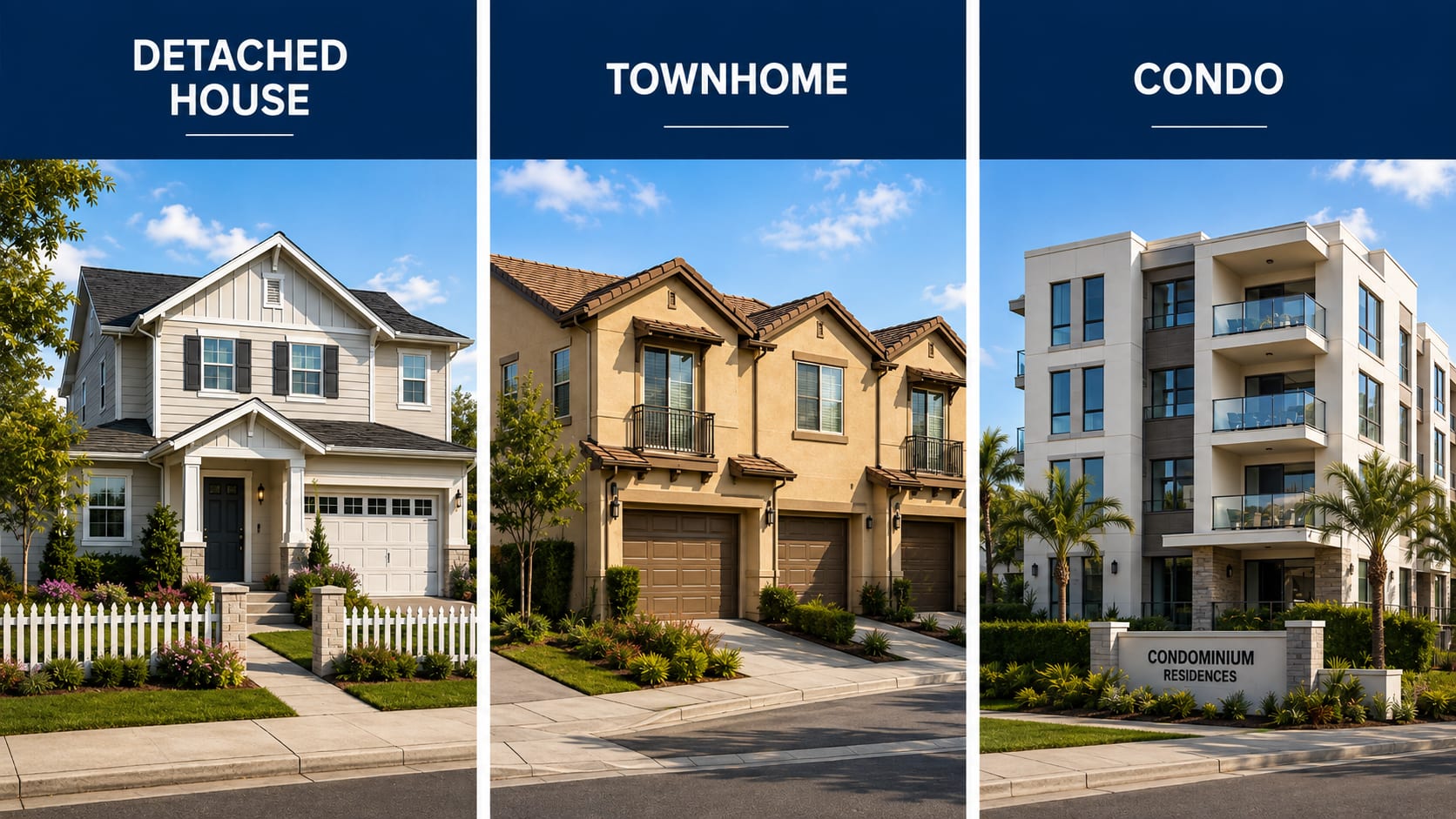

The best choice between a house, condo, and townhome is not simply whichever one has the lowest purchase price.
A buyer should compare:
Total monthly cost + maintenance responsibility + space + location + HOA obligations + privacy + future expenses
A condo may cost substantially less than a detached house but come with significant HOA dues. A detached home may have no HOA but leave the owner responsible for the roof, exterior, landscaping, drainage, and every major repair.
And a townhome can fall somewhere between the two physically while having a legal ownership structure that looks much more like either a condo or a planned development.
For a broader overview of establishing your budget and starting an Orange County home search, see Buying a Home in Orange County: What Buyers Should Know.
First, Understand What You Are Actually Buying
The labels can be confusing.
Detached house
A detached home typically gives the owner more control over the structure and land.
That can mean:
- More private outdoor space
- Fewer or no shared walls
- More room for children, pets, and vehicles
- Greater ability to modify the property
- More direct responsibility for maintenance
But a detached home can still have an HOA.
Condominium
California law defines condominium ownership based on the legal interests in the property, not simply how the building looks. A condominium generally combines a separately owned unit with an interest in common property.
The HOA may be responsible for substantial portions of the property, but exactly what it maintains depends on the governing documents.
Townhome
This is where buyers should be particularly careful with terminology.
Townhome often describes the physical style of the property rather than the legal form of ownership.
A two-story attached home with its own garage and patio might legally be a condominium. Another similar-looking property might be part of a planned development where the owner has a separately owned lot.
California's Department of Real Estate specifically cautions that subdivision type does not necessarily correspond with architectural style. A property that looks like a detached house or townhome can have different legal ownership structures.
Before comparing properties, determine what you actually own and what belongs to the association.
The Biggest Tradeoff Is Often Price Versus Space
One of the most common decisions we see Orange County buyers make is whether to pay more for additional space and control.
The detached house may offer:
- A larger yard
- More bedrooms
- More vehicle parking
- Space for pets
- Fewer shared walls
- Greater remodeling flexibility
Those can matter significantly to a family with children, several cars, large pets, or plans to expand or customize the property.
A condo may require compromising on some of those things in exchange for a lower purchase price or better location.
Neither choice is inherently better.
The useful question is:
Which compromises will affect your daily life the most?
HOA Dues Can Reduce the Condo's Price Advantage
Do not compare an $800,000 condo with a $900,000 house based solely on the $100,000 purchase-price difference.
In Orange County condo and townhome communities we currently work with, we frequently encounter HOA dues around $500 to $700 per month.
That is Legacy Real Estate's current experience, not an Orange County average.
At $600 per month, the HOA cost is:
$7,200 per year
That recurring expense affects how much home a buyer can comfortably carry.
There can also be a tax difference worth understanding. For a personal residence, HOA dues generally are not deductible on Schedule A. Qualifying mortgage interest may be deductible when the homeowner itemizes and satisfies applicable IRS requirements. Individual tax circumstances vary, so this should not be treated as tax advice.
But this still does not mean high HOA dues are automatically bad.
The next question is:
What does the HOA pay for?
A $600 HOA Can Mean Very Different Things
Consider two communities that both charge $600 per month.
One association might maintain:
- Roofs
- Exterior paint
- Landscaping
- Private streets
- Pool
- Building insurance
- Common plumbing
- Significant common areas
Another might maintain far less.
That means the monthly dollar amount alone tells you very little.
A detached homeowner with no HOA may simply pay many of those expenses directly.
This is why buyers should review the HOA financials and responsibilities before deciding whether the dues are reasonable.
California DRE recently emphasized this exact point. Buyers in common interest developments should review the governing documents to determine responsibilities for exterior and interior maintenance, insurance, assessments, and restrictions rather than making assumptions based on how the property looks.
Never Assume the HOA Covers the Entire Exterior
This is another misunderstanding we see.
A buyer sees an attached property and assumes:
"The HOA handles everything outside."
Not necessarily.
The association might maintain the roof.
Or it might not.
It could maintain exterior paint but leave certain windows, doors, patios, plumbing, or other components to the individual owner.
The responsibility can even change based on what an owner does to the property.
For example, at Brea Corsican in Brea, we have encountered association provisions where installing rooftop solar can affect the owner's responsibility for the roof afterward.
That is a very specific community example, and buyers should always confirm the current governing documents rather than assuming the same rule applies elsewhere.
The broader lesson is more important:
Do not infer maintenance responsibility from the word condo, townhome, or HOA. Read the actual documents.
High HOA Dues Do Not Guarantee You Will Avoid Special Assessments
Another assumption is:
"If I already pay a lot every month, the HOA shouldn't need to increase dues or assess me."
Unfortunately, the current dues do not guarantee that.
An association may encounter:
- Insurance increases
- Roof projects
- Plumbing repairs
- Structural work
- Deferred maintenance
- Reserve shortages
- Unexpected expenses
We have seen Orange County associations where owners were already paying substantial monthly dues and still faced increases or special assessments.
That is why financial health matters more than simply asking whether the dues are high or low.
A buyer should look at:
Current dues + reserves + upcoming projects + insurance + financial trend
Our discussion of how underfunded HOA reserves can affect condo owners explains why a seemingly inexpensive HOA can still create substantial future costs.
Insurance Is Different With an HOA Property
Insurance also changes the comparison.
With a detached home, the homeowner generally obtains coverage for the property directly.
With many condominium developments, there may be two important layers:
HOA master insurance
and
the owner's individual insurance
The exact boundary between them depends on the HOA's governing documents and policies.
That makes it risky to assume:
"The HOA has insurance, so I don't need to worry about the building."
The association may cover certain structures or common components while the owner's policy is expected to cover other portions of the property.
The details matter because they can affect both your own insurance and the association's finances.
Current Fannie Mae guidance likewise distinguishes project-level master insurance from individual unit-owner coverage in applicable condo financing.
Condo Financing Can Involve More Than the Buyer
With a detached house outside of a condo project, financing largely centers on the borrower and property.
Condo financing can add another layer:
the project itself.
Depending on the loan and property, a lender may review issues involving the association's:
- Financial condition
- Insurance
- Delinquencies
- Physical condition
- Litigation
- Project characteristics
Fannie Mae specifically describes project eligibility as a risk separate from the individual borrower's creditworthiness.
This does not mean condos are difficult to finance.
It means an otherwise qualified buyer can encounter a property-level issue that would not necessarily arise with a detached house.
Location Can Be a Good Reason to Choose a Condo
Property type can also be a way to buy into a location that otherwise might not fit your budget.
A good Orange County example is Stadium Lofts in Anaheim's Platinum Triangle.
It is a mid-rise condominium community near Angel Stadium and the area's urban-style entertainment and transportation options. Legacy has represented buyers and sellers there, and we have seen two-bedroom units around or below the $700,000 range.
For someone who specifically wants to own in that urban Anaheim location, a condo can provide an ownership option at a price point that may be difficult to duplicate with nearby detached housing.
The decision is not necessarily:
Condo versus house.
It may be:
Condo in the location I want versus detached home somewhere else.
Consider the Ability to Customize
Detached homes generally can provide more flexibility for substantial changes, subject to zoning, permits, HOA restrictions where applicable, and other requirements.
Buyers may want:
- An addition
- ADU
- Different exterior
- Major landscaping
- Expanded driveway
- Larger patio
- Pool
- Significant structural remodeling
HOA properties can add architectural rules or approval procedures.
The California DRE specifically advises common-interest-development buyers to review rules affecting pets, parking, architectural design, exterior changes, and other uses before purchasing.
If customization matters to you, investigate those restrictions before deciding the property type works for your plans.
A Three-Property Comparison
Consider this hypothetical Orange County buyer choosing among three properties:
| Condo | Townhome | Detached House | |
|---|---|---|---|
| Purchase price | $800,000 | $875,000 | $925,000 |
| HOA | $600/mo. | $350/mo. | $0 |
| Outdoor space | Balcony/common area | Patio | Private yard |
| Shared walls | Yes | Yes | No |
| Direct exterior maintenance | Lower in this example | Moderate | Higher |
| Major systems | Newer | Mixed | Older |
| Customization flexibility | More limited | Moderate | Greater |
The condo has the lowest purchase price.
But its HOA costs:
$7,200 per year
The detached home costs $125,000 more initially, but has no HOA in this hypothetical example.
That does not make the house cheaper.
The owner may eventually be paying directly for:
- Roof
- Exterior paint
- Landscaping
- Fencing
- Drainage
- Other repairs
Meanwhile, the condo association may be paying some of those expenses from monthly dues.
The townhome may provide a middle ground in price, outdoor space, garage configuration, and maintenance.
There is no winner until you know what that particular buyer values.
For a broader look at these expenses, The True Cost of Owning a Home in Orange County explains why purchase price alone does not determine ownership cost.
Resale Depends on the Individual Property
Avoid rules such as:
Houses always appreciate more.
or:
Condos are harder to sell.
Actual resale depends on factors including:
- Location
- Purchase price
- Condition
- Floor plan
- Parking
- HOA dues
- HOA financial strength
- Insurance
- Supply
- Buyer demand
- Market conditions
A well-located condo in a financially healthy development can appeal to a very different buyer pool from an attached property with high dues and major association problems.
Likewise, a detached home with substantial deferred maintenance is not automatically the stronger resale property simply because it has no shared walls.
House, Condo, or Townhome: Which Fits You?
Before narrowing your search, rank these questions:
- What total monthly housing cost is comfortable?
- Which locations matter most?
- How much space do you actually need?
- How important is a private yard?
- How many cars need to be accommodated?
- How much maintenance do you want to handle yourself?
- How comfortable are you with HOA rules?
- How much privacy do you want?
- Do amenities matter to you?
- Do you plan substantial remodeling or additions?
- How much cash can you keep available for future repairs?
- Could you want to rent the property later?
Then compare actual properties.
The answer might be a condo.
It might be a townhome.
It might be a detached house.
Or your answer may change depending on the neighborhood.
Legacy Real Estate Insights
For more Southern California housing-market data, trends, ownership costs, and practical real estate analysis, visit Legacy Real Estate Insights.
Understanding how HOA expenses, maintenance, insurance, property condition, and location affect the true cost of ownership can make property-type decisions much easier.
Still Deciding What Type of Home to Buy?
Before limiting your search to houses, condos, or townhomes, it can help to compare what your actual budget buys across several property types.
Legacy Real Estate can help Orange County buyers compare:
- Purchase prices
- HOA dues and responsibilities
- Monthly ownership costs
- Space and parking
- Maintenance obligations
- HOA finances
- Location
- Insurance considerations
- Future repair responsibility
The goal is not to decide that one property type is best.
It is to identify which combination of cost, space, location, maintenance, and control fits the way you actually want to live.

Legacy Real Estate does not provide legal, tax, lending, insurance, or financial advice.