
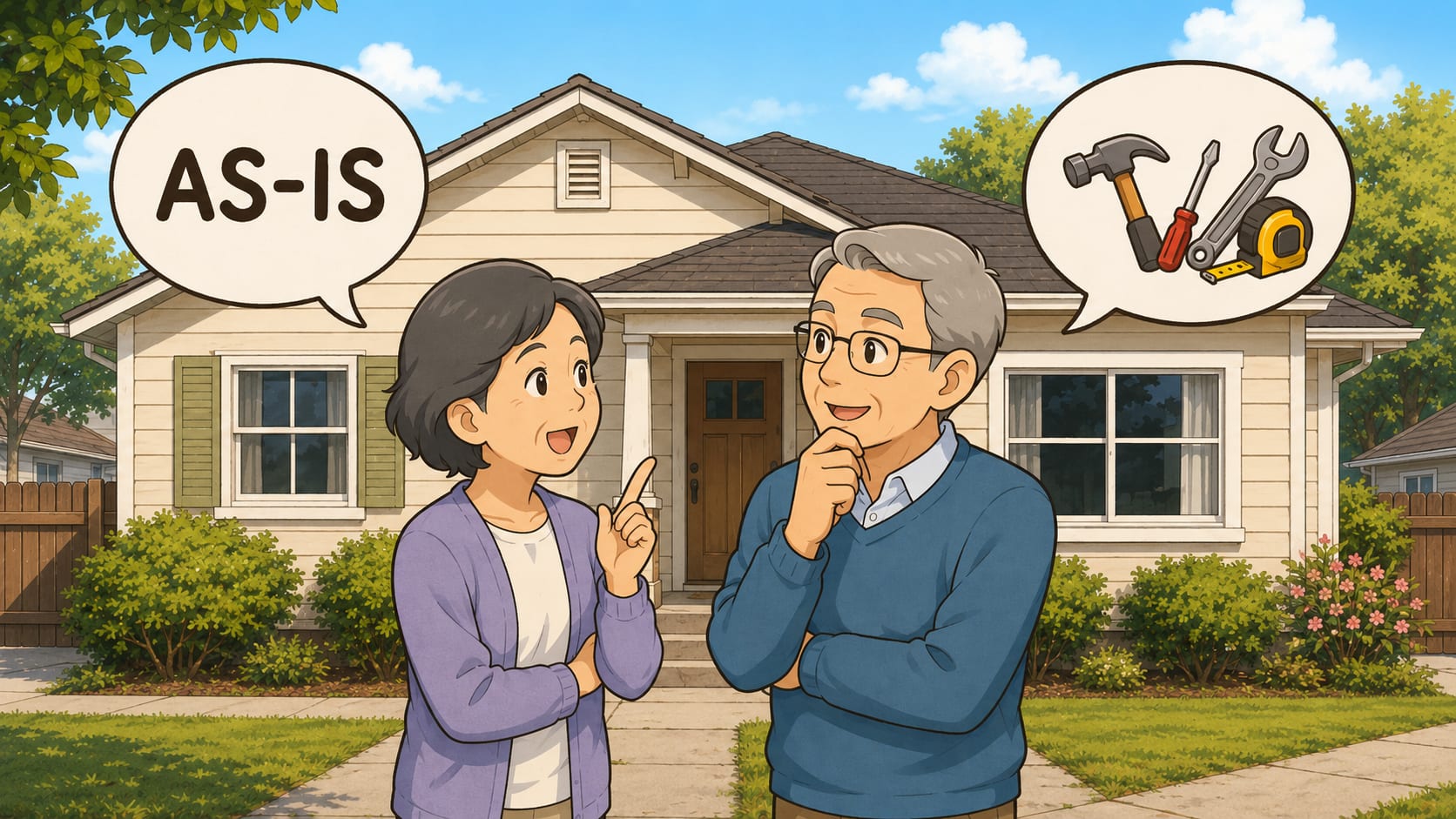

Selling a home as-is can make sense when the property needs substantial work, the seller has limited cash, or the time and effort required to manage repairs is not worth it.
But selling as-is does not mean the seller can ignore disclosures, prevent the buyer from investigating the property, or assume there will be no negotiation after an offer is accepted.
Think of as-is as a selling strategy, not a legal shield.
The real question is:
Would repairing the property before selling create enough additional value to justify the money, time, and effort?
For a broader overview of the selling process, see Selling a Home in Orange County: What Sellers Should Know.
What Does Selling a Home As-Is Actually Mean?
In practical terms, selling as-is usually means the seller intends to sell the property in its current condition rather than agreeing in advance to renovate or repair it.
That does not necessarily mean:
- The buyer cannot inspect the home
- The buyer gives up all contractual rights
- The seller can conceal known problems
- The buyer cannot request a repair or credit
- The seller must reject every request
- The buyer's deposit automatically belongs to the seller once escrow begins
In many California transactions using the California Association of REALTORS® Residential Purchase Agreement, the standard contract already provides for the property to be delivered in its present physical condition as of acceptance unless the parties agree otherwise.
The same contract framework also provides for buyer investigations when the applicable contingency has not been waived or removed.
That is why simply writing "as-is" does not eliminate the rest of the transaction.
As-Is Does Not Mean No Disclosures
This is probably the most important thing for California sellers to understand.
Selling as-is does not generally eliminate applicable disclosure obligations.
For residential transactions subject to California's statutory Transfer Disclosure Statement requirements, state law specifically says that delivery of the disclosure statement cannot simply be waived because the property is being sold as-is.
A seller should still disclose known information as required by the transaction and applicable law.
That can include information involving:
- Leaks
- Water damage
- Additions
- Repairs
- Structural problems
- Property systems
- Neighborhood issues
- HOA matters
- Other known material conditions
The better strategy is:
Disclose the problem accurately and then decide whether you want to repair it.
Those are two separate decisions.
Buyers Can Still Inspect an As-Is Property
An as-is seller may be surprised when the buyer schedules a home inspection.
That is not necessarily inconsistent with an as-is sale.
Depending on the purchase agreement and contingencies, buyers may investigate things such as:
- General property condition
- Roof
- Plumbing
- Electrical systems
- HVAC
- Foundation
- Sewer
- Termite or wood damage
- Pool
- Other property-specific concerns
The buyer may simply be trying to understand what they are agreeing to purchase.
That inspection can also change how the buyer views the property.
For the buyer's perspective on that process, see Should You Ask the Seller to Make Repairs After a Home Inspection?.
Buyers Can Still Ask for Money
One misconception about an as-is sale is:
"The buyer agreed to as-is, so they can't ask me for anything."
They can ask.
Whether they have a contractual right to cancel, whether the seller needs to agree, and what happens next depend on the purchase agreement, contingencies, timing, and circumstances.
We had an as-is transaction involving an HOA where the buyer reviewed the association's finances and found a reserve shortage equivalent to roughly $12,000 per unit.
The buyer came back requesting a concession.
The parties eventually agreed to an approximately:
$8,000 buyer credit
The seller could have refused.
Instead, the seller decided that an $8,000 adjustment made more sense than losing the transaction and going back to the market.
That is what as-is often looks like in the real world.
The seller may begin with a firm position that no repairs are planned.
New information can still come up during escrow, and the seller can decide whether compromising makes financial sense.
As-Is Does Not Mean the Buyer's Deposit Is Automatically Forfeited
Sellers can also misunderstand the buyer's earnest money deposit.
Going into escrow does not automatically make the deposit the seller's money.
The buyer may have contractual contingencies or other rights that affect whether they can cancel and whether the deposit is returned.
As contingencies are removed, the situation can change.
The exact rights depend on the purchase agreement, contingency status, cancellation circumstances, any applicable liquidated-damages provisions, and other facts.
Sellers should not evaluate an as-is offer under the assumption:
"If the buyer changes their mind, at least I automatically get the deposit."
That may not be the case.
When Does Selling As-Is Make the Most Sense?
One of the clearest situations we see is:
Major deferred maintenance + limited seller cash
A property might need:
- Roof work
- HVAC
- Flooring
- Paint
- Plumbing
- Electrical work
- Kitchen and bathroom updates
- Exterior repairs
The seller could potentially improve the home.
But that may require tens or hundreds of thousands of dollars, months of contractor coordination, and a willingness to take construction risk.
Not every seller wants to do that.
And not every seller should.
Time Has a Cost Too
The financial analysis should include more than contractor estimates.
We worked with sellers in their 90s who had accumulated properties over their lifetime.
They had reached the point where they wanted to slow down and enjoy what they had built.
The properties needed work, but coordinating contractors, renovations, and sales took time and energy.
Their health declined during the process, and both ultimately passed away before they were able to fully complete the sale of their properties and enjoy the proceeds the way they had planned.
That experience has stayed with us.
A seller can spend months trying to squeeze additional money out of a property and lose something that is much harder to calculate:
time.
The highest theoretical sale price is not automatically the best outcome.
Sometimes simplicity has real value.
When As-Is May Cost You Money
There is also a tradeoff.
Buyers do not necessarily deduct only the actual cost of repairs.
They may also account for:
- Uncertainty
- Contractor management
- Time
- Inconvenience
- Financing concerns
- Insurance concerns
- Risk that additional problems will be discovered
If a roof will cost $20,000 to replace, a buyer might perceive the problem as larger than $20,000 because they also have to find the contractor, manage the project, and accept the risk.
This can result in:
- Lower offers
- Fewer interested buyers
- Larger requested concessions
- More inspection scrutiny
That does not mean an as-is home will always sell for less than the seller would net after completing repairs.
It means the seller should compare both strategies realistically.
Price the Condition of the Home
A common mistake is looking at a fully remodeled comparable home and saying:
"That one sold for $1.1 million, so mine should too."
Maybe.
But if the comparable property has:
- New flooring
- Updated kitchen and bathrooms
- Newer HVAC
- A newer roof
- Better presentation
and the seller's house needs substantial work, buyers will usually notice the difference.
They are not just estimating construction costs.
They are comparing:
Move in now
with
Buy this property and manage a project
The asking price should reflect that difference.
As-is does not mean the seller has to give the property away.
It means condition has to be part of the valuation.
Repair Before Selling or Sell As-Is?
Here is a simpler way to compare the options.
Repair Before Selling
Potential advantages:
- Better presentation
- Fewer obvious buyer concerns
- Potentially broader buyer pool
- Less uncertainty
- Potentially stronger offers
Potential disadvantages:
- Upfront cash
- Contractor management
- Time before listing
- Construction risk
- Possibility of spending money buyers do not value
Sell As-Is
Potential advantages:
- Faster preparation
- Less upfront spending
- Less contractor coordination
- Buyer takes responsibility for future projects
- Simpler for sellers with limited time or energy
Potential disadvantages:
- Buyers may discount the property
- Some buyers may avoid a large project
- Repair uncertainty may reduce offers
- Certain conditions may create financing or insurance complications
- Buyers may still negotiate after inspections
Neither approach automatically produces the better net result.
Our guide to How Much Does It Cost to Sell a Home in Orange County? explains why preparation and negotiated credits should be included when estimating what a seller will actually receive.
As-Is Is Different From Remodeling
There are really several choices.
A seller can:
Repair something that is broken.
Improve presentation through cleaning, paint, landscaping, or decluttering.
Remodel functioning but dated areas such as kitchens and bathrooms.
Or:
Sell substantially as-is.
Those strategies can also be combined.
For example, a seller might repair an active plumbing leak, clean and declutter the home, but leave the dated kitchen and flooring for the next owner.
"As-is" does not have to mean intentionally presenting the property in the worst possible condition.
Insurance and Financing Can Complicate an As-Is Strategy
Some defects matter for reasons beyond buyer preference.
Depending on the individual property, insurer, lender, and loan, issues involving things such as:
- Roof condition
- Electrical systems
- Significant water damage
- Nonfunctioning systems
- Severe deferred maintenance
may create insurance or financing questions.
A seller can say they do not intend to repair an item.
But if the buyer cannot obtain the required financing or insurance because of the condition, the seller may eventually have to decide between addressing the problem, finding another buyer, or adjusting the price or terms.
Our article on How California Home Insurance Is Affecting Home Sales explains why insurance can become part of the selling strategy.
Ten Questions Before Deciding to Sell As-Is
Before spending money or deciding to do nothing, ask:
- How much work does the property actually need?
- What will the repairs realistically cost?
- How long will the work take?
- Do I have the cash to comfortably fund it?
- Do I want to manage contractors and the project?
- Could any condition affect insurance or financing?
- Would repairing the home significantly expand the buyer pool?
- How much uncertainty will buyers price into the property?
- What might I net after doing the work versus selling now?
- What is my time and convenience worth to me?
That last question deserves more consideration than it usually gets.
Selling As-Is Can Still Be a Normal Open-Market Sale
Selling as-is does not mean you have to sell the property to a wholesaler or accept the first cash investor offer.
An as-is home can still be:
- Professionally photographed
- Listed on the MLS
- Marketed online
- Shown to conventional buyers
- Exposed to multiple buyer types
- Negotiated competitively
Some buyers specifically want homes they can improve themselves.
Others may accept repairs if the location, lot, layout, or price makes sense.
The objective is to accurately position the property for the condition it is actually in.
Legacy Real Estate Insights
For more Southern California housing-market data, trends, and practical real estate analysis, visit Legacy Real Estate Insights.
Property condition is only one part of the decision. Pricing, buyer demand, repair costs, financing, insurance, and the seller's own timeline can all change whether repairing or selling as-is makes more sense.
Considering Selling As-Is?
Before hiring contractors or deciding to do nothing, it can help to compare the options.
Legacy Real Estate can help Orange County homeowners evaluate:
- Which problems may actually matter to buyers
- What repairs may not justify the time or cost
- How condition could affect pricing
- Whether insurance or financing could become an issue
- What the likely buyer pool may look like
- Estimated seller net proceeds under different strategies
- Whether selling substantially as-is is reasonable
Sometimes doing the work makes sense.
Sometimes a few targeted repairs are enough.
And sometimes the best decision is to sell the property in its current condition and move on.

Legacy Real Estate does not provide legal, tax, inspection, contracting, insurance, or financial advice.