

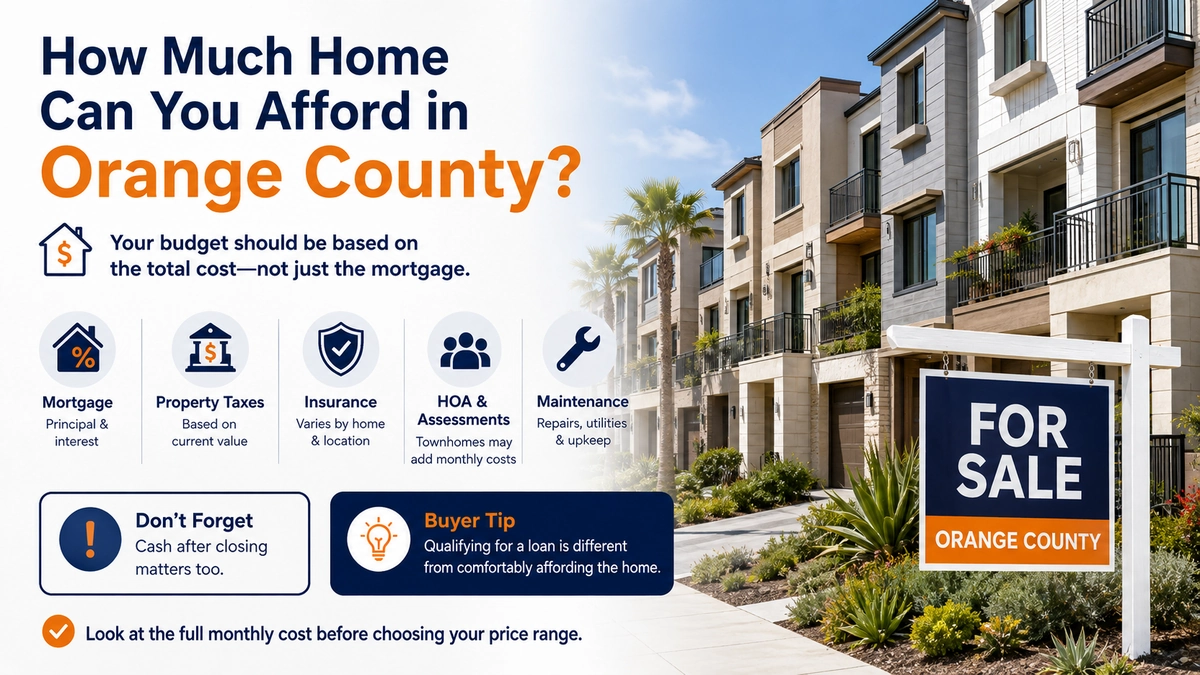
The amount a lender says you qualify to borrow and the amount of home you can comfortably afford are not necessarily the same.
We see this regularly.
A buyer may qualify for a particular payment and still look at the number and say:
I don't want to pay that every month.
That is a completely different question from whether the loan can be approved.
When deciding how much home you can afford in Orange County, consider the complete cost of the property:
- Mortgage payment
- Property taxes
- Homeowners insurance
- HOA dues
- Mello-Roos or other assessments
- Maintenance
- Utilities
- Landscaping
- Pool expenses
- Expected repairs
- Cash you want to keep after closing
Your maximum purchase price should come from those numbers together, not from a mortgage approval alone.
For a broader overview of the buying process, see Buying a Home in Orange County: What Buyers Should Know.
How Much You Qualify For Is Not Necessarily How Much You Should Spend
A lender evaluates your income, debts, assets, credit, proposed loan and other factors to determine whether you qualify under the applicable loan guidelines.
That gives you an important number.
But the lender does not decide how much of your monthly income you personally want devoted to housing.
You may also be paying for:
- Childcare
- Cars
- Travel
- Retirement savings
- Business expenses
- Education
- Family expenses
- Other savings goals
Two buyers with the same income and loan qualification can therefore be comfortable with very different housing payments.
A useful question is not simply:
What is the most I can qualify for?
Ask:
What payment could I comfortably make every month, including the months when other expenses are high?
We encourage buyers to think about the payment they can comfortably make on an ordinary month, not just what works when everything goes perfectly.
Calculate the Full Monthly Cost
A mortgage calculator typically puts the most attention on principal and interest.
Those are important, but they are only part of the cost.
Mortgage Principal and Interest
This is the repayment of the money borrowed plus the lender's interest charge.
The amount depends on factors including:
- Purchase price
- Down payment
- Loan amount
- Interest rate
- Loan term
Interest rates can materially affect buying power, so have a lender model your actual financing rather than relying on an old online calculation.
Property Taxes
Do not simply look at what the current owner pays.
California property can generally be reassessed after a qualifying change in ownership, so the seller's existing tax bill may be based on a much lower assessed value.
There can also be additional local taxes and assessments.
Use the individual property's expected taxes when comparing homes.
Homeowners Insurance
Insurance should also be property-specific.
The cost and availability can vary based on factors such as:
- Location
- Wildfire exposure
- Roof
- Property condition
- Electrical or plumbing characteristics
- Property type
- Individual insurer underwriting
Do not take the premium from the house you currently own and assume the next property will cost the same.
HOA Dues
A $600 monthly HOA payment is another $7,200 per year in recurring expense.
That does not automatically make an HOA property a poor value.
The association may cover landscaping, roofs, exterior maintenance, pools, insurance, private streets or other expenses that a detached homeowner would otherwise pay directly.
The more useful question is:
What am I paying, and what am I receiving for it?
Financial strength matters too. A low HOA payment is not necessarily better if the association is failing to adequately fund its obligations. Our guide to reviewing HOA financials before buying a condo explains what to investigate.
Mello-Roos and Other Assessments
Some Orange County properties have additional special taxes, including Mello-Roos.
Others do not.
That means two homes with the same purchase price can have different tax bills.
Do not assume a lower purchase price automatically creates the lower monthly payment.
Check the actual property.
The Costs Buyers Forget Come After the Payment
One of the bigger affordability mistakes we see is stopping after:
Mortgage + property taxes + insurance + HOA
Owning the house itself costs money too.
Depending on the property, that could include:
- Landscaping
- Pool service
- Water
- Electricity
- Gas
- Repairs
- Appliances
- Plumbing
- HVAC
- Roof
- Windows
- Exterior maintenance
Those expenses do not necessarily arrive evenly every month.
That can make them easier to ignore when establishing a home-search budget.
An HVAC system might work for years and then suddenly require a repair or replacement costing $10,000 or more.
The fact that the expense did not appear on your mortgage statement does not make it any less real.
For a deeper breakdown of these expenses, see The True Cost of Owning a Home in Orange County.
The Same Purchase Price Can Mean Very Different Affordability
Consider this clearly hypothetical example.
Both homes sell for:
$1,000,000
Assume the buyer uses the same down payment and financing for each, so the mortgage principal and interest are essentially the same.
Also assume similar property taxes and insurance simply to isolate the property-specific differences.
Home A: Older Detached Home
- Purchase price: $1,000,000
- HOA: $0
- Mello-Roos: $0
- Older HVAC that may need replacement
- Greater near-term maintenance expected
Home B: Newer HOA Home
- Purchase price: $1,000,000
- HOA: $600 per month
- Mello-Roos: $350 per month
- Newer major systems
- Less expected near-term maintenance in this example
Home B has:
$950 per month
or:
$11,400 per year
of additional fixed HOA and Mello-Roos expenses.
But Home A may require a $10,000-plus HVAC replacement or other repairs sooner.
Which one is more affordable?
There is not enough information to answer.
That is the point.
The purchase price alone does not tell you.
One buyer may prefer the predictable $950 monthly expense and newer systems.
Another may prefer the older property with lower fixed expenses and keep money available for repairs.
Affordability is property-specific.
Work Backward From the Monthly Payment You Actually Want
Instead of beginning with:
I am approved for $1 million, so show me $1 million houses
try starting with:
What total monthly housing cost am I comfortable carrying?
Then subtract the property-specific expenses.
Conceptually:
Comfortable monthly housing budget
minus
Property taxes
minus
Insurance
minus
HOA
minus
Mello-Roos
minus
A reasonable allowance for property expenses
equals the amount available for the mortgage payment.
Then have your lender model the purchase price and loan structure that fit those numbers.
This can produce different search ranges for different properties.
You might comfortably afford a $1 million house without an HOA but decide that a $1 million condo with substantial dues pushes the monthly cost higher than you want.
Your Down Payment Is Also a Tradeoff
Putting more money down generally reduces the amount you need to borrow.
That can lower the monthly mortgage payment and may affect mortgage-insurance requirements and loan pricing depending on the loan.
But putting more money down also means that cash is no longer sitting in your bank account.
Suppose a buyer has enough money available to make a larger down payment.
The decision should not automatically be:
Put every possible dollar into the house.
The buyer also needs money for:
- Closing expenses
- Moving
- Furniture
- Immediate repairs
- Emergency expenses
- Future maintenance
- Other financial priorities
Sometimes the financially comfortable choice is a larger down payment.
Sometimes preserving additional cash matters more.
Have the lender show you several scenarios instead of assuming there is only one correct down-payment amount.
Keep Money After Closing
The affordability calculation should not end on closing day.
We prefer buyers to think about maintaining a meaningful emergency fund after the purchase.
A useful planning target can be around six months of total household expenses, including the new housing payment, utilities and recurring services.
That is not a mortgage requirement and will not be the appropriate amount for every household.
For many buyers we work with, however, six months of actual expenses can easily mean $20,000 or more.
Why does this matter?
Imagine closing on a house and discovering a few months later that the HVAC needs more than $10,000 of work.
That is inconvenient if you have cash reserves.
It can become a financial crisis if virtually every dollar went into the down payment and closing costs.
The question is not just:
Can I afford to close?
It is:
What will my financial position look like the day after I close?
Property Condition Can Change Your Price Range
A buyer might technically be able to purchase a $950,000 home.
But what if that property immediately needs:
- HVAC
- Flooring
- Plumbing
- Paint
- Electrical work
The less expensive house may actually put more pressure on the buyer's finances than a slightly more expensive property with recently replaced systems.
This is why property condition needs to be incorporated into affordability.
If you are considering older housing, investigate the condition of major systems rather than focusing only on the year the property was built.
A beautifully remodeled kitchen does not necessarily mean the roof, plumbing, electrical and HVAC were also replaced.
Older Versus Newer Homes Have Different Cost Profiles
An older property may offer:
- No HOA
- No Mello-Roos
- Larger lot
- Established neighborhood
but potentially require more money for:
- Roof
- HVAC
- Plumbing
- Electrical work
- Windows
- Remodeling
A newer home may offer newer systems and fewer immediate repairs but come with HOA dues or additional assessments.
Neither is automatically cheaper.
The right comparison is:
Purchase price + monthly obligations + condition + future expenses
not simply:
Which house costs less?
Condo Versus House Can Change Affordability Too
A condo may have a lower purchase price than a detached house.
But if the condo has a substantial monthly HOA payment, the difference in monthly cost may be smaller than the price difference suggests.
On the other hand, that HOA may maintain the roof, exterior, landscaping, insurance or common amenities.
A detached homeowner may pay those costs directly instead.
When comparing property types, look at both:
What you pay
and
what you are responsible for maintaining yourself.
Do Not Search Only at Your Maximum Approval
Suppose a lender approves a buyer up to $1.1 million.
That does not mean every property below $1.1 million fits equally well.
A $1.05 million property with substantial HOA dues, additional assessments and expensive insurance can create a very different monthly expense from another $1.05 million property without those obligations.
Likewise, a $950,000 fixer needing significant immediate work can demand more cash than a $1 million move-in-ready property.
Treat the loan approval as an important boundary.
Then determine your actual search range based on the properties you are considering.
Before You Set Your Maximum Search Price
Estimate these ten things:
- The total monthly housing payment you actually want
- Your expected down payment
- Closing costs and other purchase expenses
- Property taxes
- Homeowners insurance
- HOA dues
- Mello-Roos or other assessments
- Routine maintenance and property-specific expenses
- Likely near-term repairs
- How much cash you want remaining after closing
Then have a lender model several purchase prices.
You may discover that your comfortable search range is lower than the maximum approval.
You may also discover that you can comfortably afford more than you expected.
The important part is knowing why.
Legacy Real Estate Insights
For more Southern California housing-market data, trends, ownership-cost information, and practical real estate analysis, visit Legacy Real Estate Insights.
Affordability changes with interest rates, prices, insurance, taxes, HOA expenses and the characteristics of the individual property. Looking beyond the listing price can make those tradeoffs much easier to understand.
Still Deciding What Price Range to Search?
You do not need to know your exact maximum purchase price before you start learning about the market.
But before narrowing your search by list price alone, it can help to compare the complete monthly and long-term costs of the types of homes you are considering.
Legacy Real Estate can help Orange County buyers compare properties based on:
- Purchase price
- HOA and assessments
- Property taxes
- Insurance considerations
- Property condition
- Expected repairs
- Monthly ownership costs
- Cash needed before and after closing
Then your lender can help determine which financing structures fit your actual circumstances.
The goal is not to buy the most expensive home you qualify for.
It is to identify a price range where the home and the ongoing costs both make sense for you.

Legacy Real Estate does not provide mortgage, tax, investment, insurance or financial advice