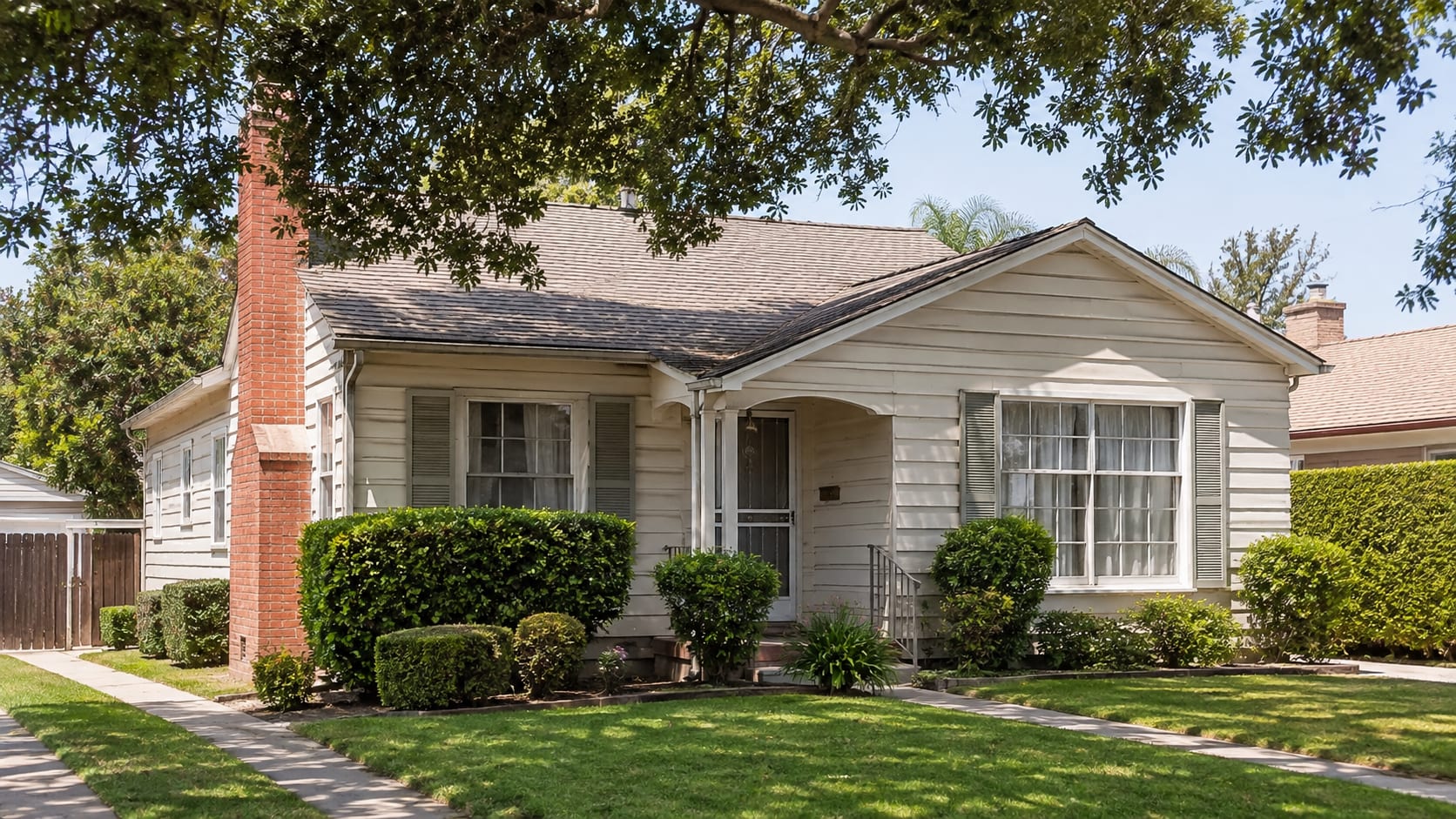
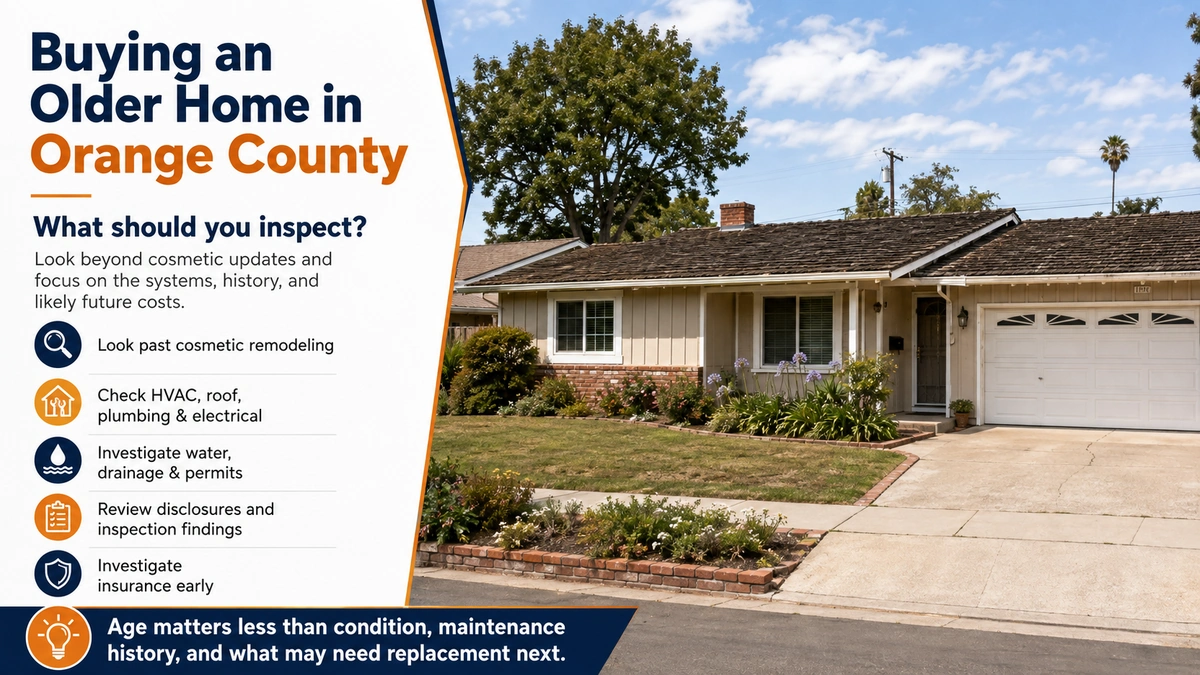
Buying an older home does not mean buying a problem.
Many older Orange County homes have larger lots, established neighborhoods, mature landscaping, and locations that are difficult to duplicate in newer developments.
But buyers should look beyond paint, flooring, and countertops.
The more important questions are:
What major systems have already been replaced?
What is still original or approaching replacement?
What has been repaired over the years?
And what might require significant money or disruption after you move in?
The age of the house gives you context. The actual condition and history of the property matter much more.
For the broader buying process, see Buying a Home in Orange County: What Buyers Should Know. Buying a Home in Orange County: What Buyers Should Know
Start With the Seller Disclosures
Before or alongside the inspection, read the seller disclosures carefully.
Older homes have had more time for things to happen.
Look for references to:
- Roof leaks
- Plumbing repairs
- Electrical work
- HVAC replacement
- Foundation work
- Drainage problems
- Additions
- Converted garages or patio enclosures
- Remodeling
- Water intrusion
- Permits
- Recurring problems
A long history is not automatically bad.
A 1965 home may have had several roofs, multiple water heaters, plumbing repairs, and remodeling over the years simply because it has existed for six decades.
The useful question is:
What happened, what was repaired, and is there anything we should investigate today?
Seller disclosures should help guide the inspection. They do not replace it.
Separate Cosmetic Condition From System Condition
This is one of the biggest mistakes buyers can make with remodeled older homes.
A house may have:
- New flooring
- New cabinets
- Quartz countertops
- Fresh paint
- New fixtures
while still having:
- An old HVAC system
- Older plumbing
- Limited electrical capacity
- An aging roof
- Deferred exterior maintenance
We have seen beautifully updated properties where the old air-conditioning condenser suddenly stands out because everything surrounding it looks new.
Buyers naturally think:
If everything else was remodeled, why wasn't this replaced?
That does not necessarily mean there is anything wrong with the HVAC system.
But it illustrates why cosmetic remodeling should not be confused with mechanical updating.
Pay Close Attention to the HVAC System
HVAC is one of the major expenses we regularly encounter in older Orange County homes.
Some houses still have equipment that has been operating for decades.
Do not assume an HVAC system needs replacement simply because it is old.
Instead, look at:
- Approximate age
- Current operation
- Maintenance history
- Previous repairs
- Heating and cooling performance
- Condition of the equipment
- Condition of accessible ductwork
- Whether replacement appears likely in the near future
ENERGY STAR recommends that homeowners at least consider replacement when air-conditioning equipment is more than 10 years old or furnaces are more than 15 years old, particularly when equipment needs frequent repairs or performs poorly. That is guidance, not a guarantee that equipment will fail at a particular age.
For a buyer looking at equipment that is several decades old, the question is not simply:
Does it turn on today?
It is also:
Should I financially prepare to replace this after I buy the house?
Understand the Electrical System and Its Capacity
Electrical systems deserve similar attention.
An older home may have had electrical work performed at several different times as kitchens, additions, air conditioning, appliances, and other features were added.
Look at:
- Main electrical panel
- Service capacity
- Visible wiring conditions
- Grounding where applicable
- Outlet condition
- Signs of amateur modifications
- Electrical changes associated with additions or remodeling
A 100-amp electrical service is not automatically defective.
But today's buyers may want substantially more electrical capacity than an older house originally needed.
Electric-vehicle charging, electric appliances, heat pumps, additions, and other equipment can change the load calculation. Southern California Edison specifically addresses panel capacity when homeowners add major electrical loads such as Level 2 EV charging.
If future electrical use matters to you, have a qualified electrician evaluate the actual system rather than assuming an older panel must be replaced or assuming it will meet every future need.
A Real Brea Electrical Negotiation
We represented a seller in Brea where the buyer wanted the electrical system substantially rewired along with a new panel.
The estimated cost was approximately:
$14,000
The seller declined the request.
The transaction did not move forward, and approximately four months later the property eventually sold for around $30,000 less.
That does not mean declining the electrical work directly caused a $30,000 loss. Market conditions, the next buyer, timing, and other factors also affect a sale.
But it illustrates something buyers and sellers both need to understand.
A $14,000 property issue can have a larger effect on negotiations if buyers are uncertain about the scope, inconvenience, or future cost.
Getting a realistic professional estimate can therefore be more useful than guessing what a problem is worth.
Plumbing Can Become Expensive When Access Is Difficult
Older plumbing deserves attention because some of the expensive part of plumbing work is not necessarily the pipe itself.
It can be getting to the pipe.
Look for:
- Visible corrosion
- Leaks
- Water pressure
- Previous repairs
- Drain performance
- Water-heater condition
- Older piping materials
- Evidence of water damage
- Repeated plumbing disclosures
Older drain or supply lines concealed under concrete or inside walls can become much more expensive to address if access requires opening walls, floors, or slabs.
A normal home inspection cannot necessarily tell you the condition of every concealed pipe.
Depending on the property's age, symptoms, inspector's observations, landscaping, and plumbing history, further investigation such as a plumber or sewer inspection may sometimes make sense.
That does not mean every older home automatically needs every possible specialist inspection.
Look at the Roof, but Do Not Judge It Only by Age
Roofs get a lot of attention because replacement can be expensive and because roof condition may also matter to homeowners insurance.
Look for:
- Approximate age when known
- Visible deterioration
- Prior leak disclosures
- Previous repairs
- Flashing
- Drainage
- Evidence of water intrusion
- Signs that replacement may be approaching
An older functioning roof is different from a roof that is actively leaking.
And an old roof does not automatically mean the buyer should refuse the property.
The real question is whether the roof is currently performing and what expense the buyer should reasonably anticipate after purchase.
Uneven Floors and Cracks Need Context
Older houses move.
Concrete cracks.
Floors are not always perfectly level.
Buyers sometimes become alarmed immediately when they notice an uneven floor or crack.
Those conditions should not simply be ignored, but appearance alone does not diagnose a foundation problem.
Look for the larger pattern.
Are there:
- Unusual or significant cracks?
- Doors or windows that no longer operate properly?
- Noticeably changing floor elevations?
- Previous foundation repairs?
- Moisture or drainage problems?
- Signs that movement may be continuing?
If the general inspector identifies a structural concern, that may be the time to obtain an appropriate specialist evaluation.
Foundation recommendations can become expensive, so significant findings are also an area where obtaining more than one qualified opinion may be valuable.
Water Usually Deserves More Investigation Than the Stain
An old ceiling stain is not necessarily important by itself.
The more useful question is:
Why did it get wet?
Water can come from:
- Roof leaks
- Plumbing leaks
- Windows or doors
- Drainage
- Exterior walls
- Patios or additions
- Grading
- Other sources
If the seller says the underlying problem was repaired, look for information about the repair and tell the inspector about the history.
Do not focus only on whether someone painted over the stain.
Try to determine whether the source was corrected and whether there is evidence the problem returned.
Investigate Additions and Remodeling
Older Orange County homes may have been modified several times.
You may encounter:
- Added bedrooms
- Converted garages
- Patio enclosures
- Expanded kitchens
- Added bathrooms
- Removed or relocated walls
- Electrical changes
- Plumbing changes
Where permit status or workmanship raises questions, investigate further.
California's Contractors State License Board notes that many types of building alterations require permits and directs homeowners to the appropriate local building department because requirements can vary by jurisdiction.
Do not automatically assume unpermitted work makes a house unacceptable.
But also do not assume obtaining approval later will be easy.
Consider how the work could affect your planned use of the property, future remodeling, insurance, financing, valuation, or resale.
Inspect the Exterior, Windows, and Drainage
Some older-home expenses are less dramatic but still add up.
Look at:
- Exterior paint
- Stucco or siding
- Wood trim
- Windows
- Doors
- Drainage
- Grading
- Deteriorated exterior materials
- Signs of moisture
- Termite or other wood damage
Older single-pane windows do not automatically need replacement.
Likewise, worn exterior paint may simply be a future maintenance expense.
The purpose of the inspection is to distinguish routine ownership maintenance from a condition that could become substantially more expensive.
Do Not Forget Termite and Wood Damage
Southern California buyers may also encounter wood-destroying organisms or deterioration associated with moisture.
Depending on the property, further pest evaluation may be useful when there is evidence of:
- Wood damage
- Previous treatment
- Dry rot
- Moisture damage
- Deteriorated exterior wood
- Other visible pest concerns
A pest inspection is not automatically required in every transaction.
The need depends on the property, purchase agreement, financing, buyer's concerns, and other circumstances.
Investigate Insurance Early
An older house may create insurance questions that are unrelated to whether you personally like the property.
Insurers can consider property characteristics such as roof condition, electrical and plumbing systems, prior losses, wildfire exposure, and overall condition when underwriting coverage.
That does not mean an older home is automatically difficult to insure.
It means you should investigate the specific property.
Waiting until the final days before closing can leave very little time to solve an unexpected insurance problem.
For more detail, see Homeowners Insurance During Escrow in Orange County: What Buyers Should Know
Think About the Time Required for Repairs Too
Buyers tend to focus on repair cost.
They often underestimate repair disruption.
Suppose a property needs $20,000 of work.
That does not tell you whether the project takes two days or keeps part of the house unusable for several weeks.
Interior flooring and painting can be particularly inconvenient because furniture may need to be moved and large portions of the house can be difficult to use during the project.
Other projects, such as certain roof or window replacements, may sometimes interfere less with actually living inside the home, depending on the scope.
When evaluating an older house, consider:
Cost + Time + Disruption
That can matter almost as much as the contractor estimate.
Age vs. Condition Matters More Than the Year Built
Imagine two properties.
House A
Built decades ago, but has:
- Updated HVAC
- Updated electrical
- Significant plumbing work already completed
- Newer roof
- Documented maintenance
House B
Built considerably later, but still has:
- Original mechanical systems
- Deferred maintenance
- An older roof
- Unresolved leaks
Which house will cost less over the next five years?
You cannot answer based on the construction year alone.
This is why we encourage buyers to evaluate the actual systems, rather than automatically favoring the newer home.
The same principle applies to ownership costs generally. Two homes with similar purchase prices can require very different amounts of money after closing.
For a deeper comparison, see The True Cost of Owning a Home in Orange County. The True Cost of Owning a Home in Orange County
When Should You Bring in a Specialist?
A general home inspection is the starting point, not necessarily the final investigation.
California's Department of Real Estate specifically encourages buyers to investigate major systems including electrical, plumbing, HVAC, roof, foundation, and structural condition.
Depending on what the property and general inspection reveal, additional evaluation might involve a:
- Roofer
- Electrician
- Plumber
- HVAC contractor
- Structural or foundation professional
- Sewer specialist
- Pest inspector
- Pool professional
You do not need to hire every specialist for every older home.
Let the property's history, disclosures, visible condition, general inspection, and your own concerns guide the next step.
What Happens If the Inspection Finds Something Expensive?
Finding a problem does not automatically mean the seller has to fix it.
Depending on the purchase agreement, contingency status, timing, property condition, and negotiating leverage, a buyer may decide to:
- Proceed as agreed
- Investigate further
- Request a repair
- Request a seller credit
- Request another adjustment
- Exercise applicable contractual rights
The most useful negotiations usually focus on the items that materially change the buyer's view of the property.
For more on that decision, see Should You Ask the Seller to Make Repairs After a Home Inspection?
Ten Questions to Ask Before Buying an Older Home
Before deciding whether an older Orange County home makes sense, try to answer:
- How old are the major systems?
- Which major components have already been replaced?
- What repairs or recurring issues did the seller disclose?
- Are there signs of water or drainage problems?
- Have major additions or remodels been completed?
- Are there electrical or plumbing issues that deserve more investigation?
- What does the general inspector recommend evaluating further?
- Could any property condition affect insurance?
- What major expenses might occur during the next several years?
- Does the price make sense given the home's actual condition?
You are not trying to eliminate every future repair.
That is impossible with any home.
The objective is to understand what you are buying well enough that the major expenses do not come as a complete surprise.
Legacy Real Estate Insights
For more Southern California housing data, market trends, and practical real estate analysis, visit Legacy Real Estate Insights
Older housing is one area where market value, condition, repair costs, insurance, and long-term ownership expenses all intersect.
Understanding those tradeoffs can help a buyer compare properties more intelligently than simply asking which house was built more recently.
Considering an Older Home in Orange County?
Legacy Real Estate can help buyers look at the property as a whole:
- Major system condition
- Seller disclosures
- Inspection findings
- Questions that may justify specialist review
- Expected repair costs
- Insurance considerations
- Immediate versus future expenses
- How the condition compares with the asking price
An older house can be an excellent purchase.
The goal is not to avoid age.
It is to understand what has already been done, what still works, and what you may have to take care of next.

Legacy Real Estate does not provide legal, inspection, engineering, contracting, insurance, or other professional advice.