

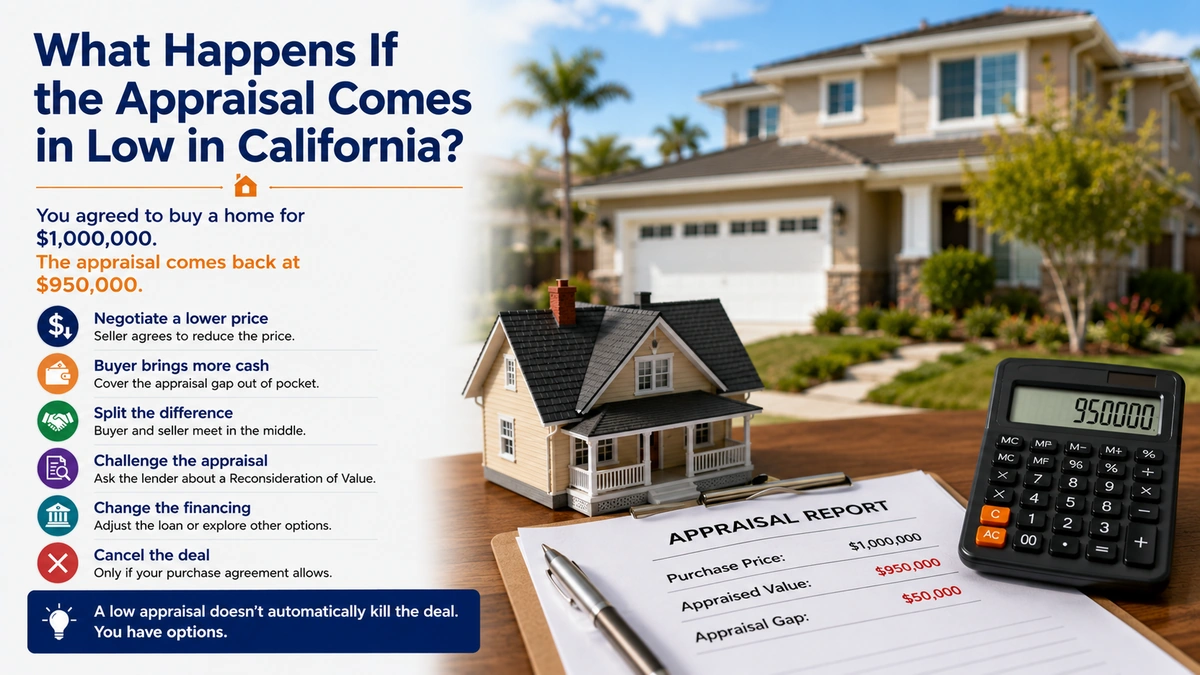
You agreed to buy a home for $1 million.
Then the appraisal comes back at:
$950,000.
What happens now?
A low appraisal does not automatically reduce the purchase price, and it does not automatically end the transaction.
The buyer and seller already agreed to a contract price. The appraisal is the appraiser's opinion of the property's market value, primarily used by the lender when evaluating the loan.
If the appraisal is lower than the purchase price, the parties may have several options depending on the contract, financing and buyer's available cash:
- Negotiate a lower price
- Have the buyer bring in additional cash
- Meet somewhere in the middle
- Ask the lender about challenging the appraisal
- Change the financing
- Cancel if the contract gives the buyer that right
The first step is understanding what the low appraisal actually changes.
Why Does the Appraisal Matter?
When a buyer is financing a home, the lender is evaluating both the borrower and the property being used as collateral.
The appraiser provides an independent opinion of the property's market value. Fannie Mae explains how home appraisals work and why the appraised value can affect financing.
This is an important distinction:
Purchase price: What the buyer and seller agreed to.
Appraised value: The appraiser's opinion of the property's market value.
A low appraisal does not automatically replace the purchase price with the appraised value.
Instead, it can create a financing gap that the buyer and seller need to address.
An appraisal is also different from a home inspection. An appraisal focuses primarily on value for lending purposes, while an inspection focuses on the property's condition. For inspection-related negotiations, see Should You Ask the Seller to Make Repairs After a Home Inspection?.
A Simple Appraisal Gap Example
Suppose a buyer agrees to purchase an Orange County home for:
$1,000,000
The buyer plans to put:
20% down
or:
$200,000
The expected loan is:
$800,000
But the appraisal comes back at:
$950,000
Depending on the loan program and lender requirements, the lender may calculate the financing using the lower appraised value.
That can mean the buyer needs more cash than originally expected if they want to keep the same purchase price.
The buyer and seller then have to decide what happens next.
Option 1: The Seller Lowers the Purchase Price
The buyer may ask the seller to reduce the purchase price.
For example:
Contract price: $1,000,000
Appraised value: $950,000
The buyer could ask the seller to reduce the price to $950,000.
The seller may agree, decline or offer a smaller reduction, depending on the contract and circumstances.
A seller may believe the appraisal is too low or that another buyer would pay closer to the original price.
The buyer may believe the appraisal shows that the agreed price is difficult to support.
That creates a new negotiation.
Option 2: The Buyer Brings More Cash
The buyer may decide the home is still worth the agreed purchase price and contribute additional cash.
Using the same example:
Purchase price: $1,000,000
Appraised value: $950,000
Appraisal gap: $50,000
This does not necessarily mean the buyer simply adds exactly $50,000 to the original down payment.
The effect depends on the loan amount, loan-to-value requirements and lender.
The buyer should have the lender calculate the actual:
Loan amount + Down payment + Cash to close
before deciding how to proceed.
Bringing additional cash may make sense when the buyer strongly prefers the property and has the financial ability to do so.
But that additional cash should also be considered as part of the property's total cost. See The True Cost of Owning a Home in Orange County for a broader look at evaluating ownership costs.
Option 3: The Buyer and Seller Meet in the Middle
The solution does not have to be all or nothing.
The seller can reduce the price while the buyer brings additional cash.
For example:
Contract price: $1,000,000
Appraisal: $950,000
The parties might agree on a new price of:
$975,000
The seller gives up part of the original price, while the buyer takes responsibility for the remaining appraisal gap.
Whether that makes sense depends on the property, market, financing and motivations of both parties.
Option 4: Challenge the Appraisal
An appraisal is an opinion of value.
If there are legitimate concerns with the report, the buyer can discuss a Reconsideration of Value, commonly called an ROV, with the lender.
Possible issues might include:
- Important comparable sales that were overlooked
- Incorrect property information
- Errors involving square footage or features
- Significant differences between the property and the selected comparables
- Other factual or analytical concerns
Comparable sales matter because appraisers consider recent sales of similar properties when developing an opinion of value.
A reconsideration should therefore be based on specific information, not simply:
“We need the appraisal to be higher.”
Fannie Mae has information on the Reconsideration of Value process.
There is no guarantee the appraised value will change.
Option 5: Change the Financing
Sometimes the buyer and lender can adjust the financing.
Depending on the loan and buyer's qualifications, possibilities could include:
- Increasing the down payment
- Changing the loan amount
- Changing the loan structure
- Exploring another financing option
This is why the lender should be involved quickly after a low appraisal.
Before negotiating with the seller, the buyer should understand exactly how the appraisal affects their financing and cash needed to close.
Can the Buyer Cancel Because of a Low Appraisal?
Possibly.
But this depends on the purchase agreement and the specific circumstances of the transaction.
A California purchase agreement may contain an appraisal contingency that provides the buyer with certain protections if the property does not appraise at the required value.
However, buyers should not assume a low appraisal automatically gives them the right to cancel.
The answer may depend on:
- The language of the purchase agreement
- Whether there is an appraisal contingency
- Whether that contingency has already been removed
- Any appraisal-gap language in the offer
- Financing terms
- Contract deadlines
- Required notices
The specific contract should be reviewed before deciding what rights either party has.
What Is an Appraisal Gap Agreement?
Some buyers agree in advance to cover part of an appraisal shortage.
For example, a buyer might offer:
$1,000,000 with the buyer agreeing to cover an appraisal shortage up to $25,000.
If the appraisal comes in at:
$985,000
the difference is:
$15,000
Depending on the exact contract language, the buyer may already have agreed to cover that amount.
But suppose the appraisal comes in at:
$950,000
The gap is now $50,000, which is greater than the example $25,000 commitment.
What happens with the remaining difference depends on the actual agreement.
Buyers should understand appraisal-gap language before submitting the offer, because it can substantially change the amount of cash they may need.
For a broader discussion of evaluating a purchase before committing, see Buying a Home in Orange County: What Buyers Should Know.
Does a Low Appraisal Mean the Buyer Overpaid?
Not necessarily.
An appraisal and an agreed purchase price measure related but different things.
A home may have characteristics that are difficult to compare with recent sales, such as:
- Extensive remodeling
- A superior lot
- A view
- An unusual floor plan
- A particularly desirable location
- Features that few nearby properties share
This can be especially important in Orange County neighborhoods where an extensively renovated home may be surrounded by more original properties, or where lots, views and condition vary significantly.
Recent comparable sales can also lag what buyers and sellers are negotiating in a changing market.
On the other hand, a low appraisal may be useful evidence that the agreed purchase price is higher than recent comparable sales support.
The useful question is not simply:
Who is right?
It is:
What evidence supports the value, and does the property still make sense to the buyer at the agreed price?
What We've Seen in Orange County
In one of our Orange County transactions, the property was under contract for:
$1,050,000
The appraisal came back at:
$1,020,000
That created a:
$30,000 appraisal gap
Rather than have either side take responsibility for the entire difference, the buyer and seller agreed to meet roughly halfway.
The seller reduced the purchase price by about $15,000, while the buyer brought additional cash to handle the remaining difference.
We did not pursue a reconsideration of value in that transaction, although we have challenged appraisals in other situations when there was information we believed deserved another look.
In this case, compromise made more sense.
The seller avoided losing the transaction and putting the property back on the market. The buyer was able to purchase a home that met their needs.
Neither side got everything they might have wanted after receiving the appraisal, but both were happy with the outcome.
That is an important point about low appraisals:
Sometimes the best solution is not proving that one side is right. It is finding a reasonable way to keep a transaction that still makes sense for both parties together.
What Should a Buyer Do After a Low Appraisal?
Do not react to the appraisal number alone.
First, ask the lender exactly how the lower value changes the financing.
Then review:
- The appraisal report
- The purchase agreement and appraisal contingency
- The additional cash that may be required
- Comparable recent sales
- Whether there are legitimate grounds for a reconsideration of value
- Whether the seller is willing to negotiate
- Whether the property still makes sense at the resulting price
The right solution will vary from one transaction to another.
A Low Appraisal Does Not Have to End the Transaction
A low appraisal can feel like a major setback when it first arrives.
But often it creates a problem that can still be solved through some combination of:
Price + Cash + Financing + Negotiation
Sometimes the seller reduces the price.
Sometimes the buyer brings more cash.
Sometimes both sides compromise.
Sometimes an appraisal is reconsidered.
And sometimes the numbers no longer make sense and the transaction does not move forward.
The important thing is to understand what the appraisal actually changes before deciding what to do next.
For more Orange County housing market data, trends and real estate analysis, visit Legacy Real Estate Insights.

Legacy Real Estate does not provide legal, appraisal or lending advice.