

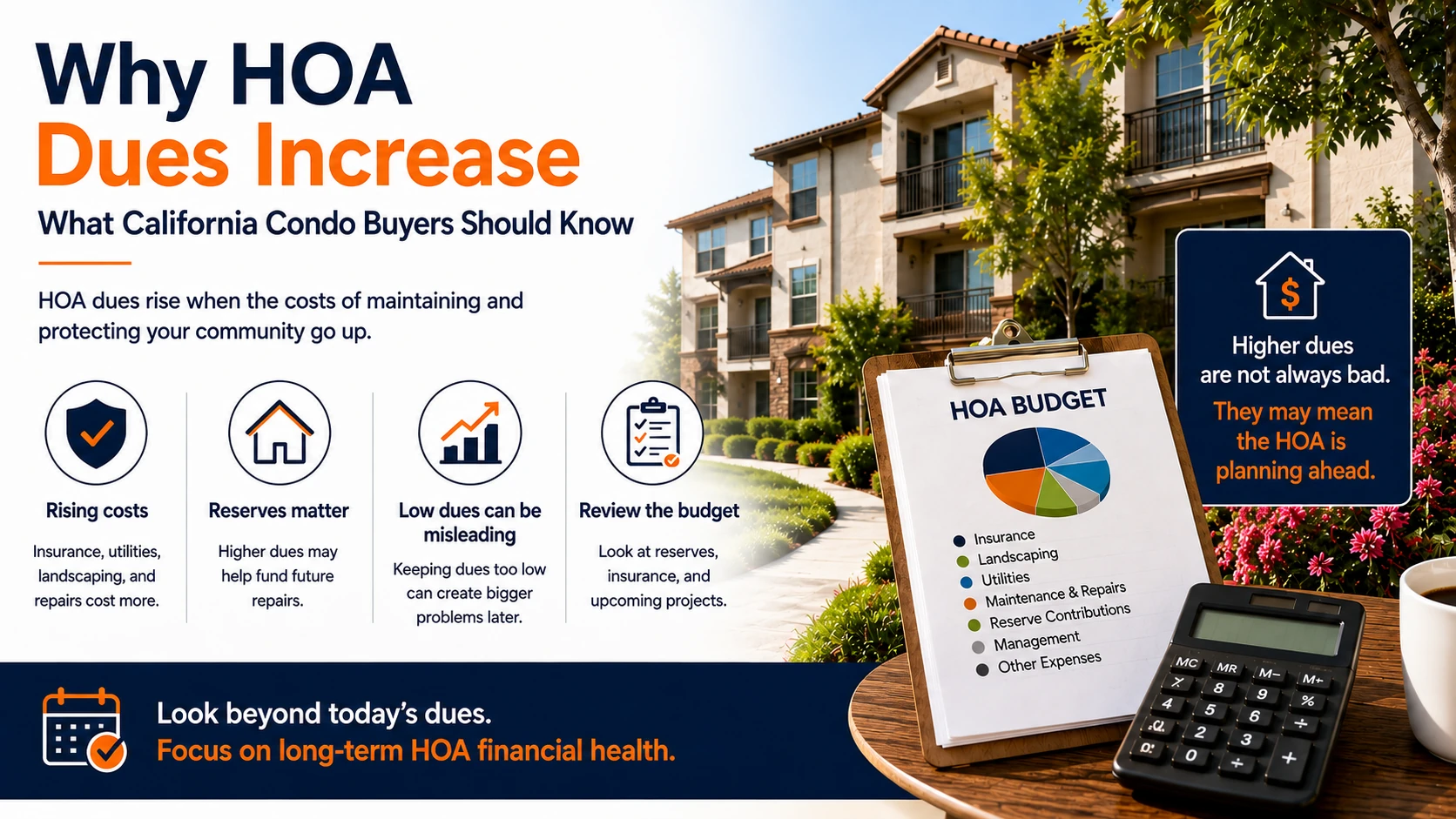
HOA dues usually increase for a simple reason:
The association's expenses and future obligations increase.
Insurance, landscaping, pools, utilities, management, roofs, repairs, and reserve contributions all cost money. As those costs change, the amount collected from homeowners may also need to change.
That does not automatically mean the HOA is poorly managed.
In fact, an association that refuses to increase dues while its costs rise can sometimes create a larger financial problem later.
For buyers, the important question is not simply:
"How much are the HOA dues today?"
It is:
"What does the HOA pay for, why have dues been changing, and is the association collecting enough to meet its obligations?"
For a deeper review of budgets, reserves, insurance, delinquencies, and meeting minutes, see How to Review HOA Financials Before Buying a Condo.
What Do HOA Dues Actually Pay For?
Every association is different.
Depending on the community, HOA dues may fund some combination of:
- Landscaping
- Pools and spas
- Building insurance
- Roofs
- Exterior maintenance
- Private streets
- Gates
- Common-area utilities
- Water or trash
- Management
- Security
- Common plumbing
- Reserve contributions
This is why comparing two communities solely by their monthly HOA payment can be misleading.
A $600 HOA maintaining roofs, exterior paint, landscaping, streets, pools, and insurance is financially different from a $600 HOA responsible for much less.
The first question should always be:
What is the association actually responsible for?
Insurance Can Put Pressure on HOA Dues
Insurance has become an important budget item for many California associations.
If the association's master-policy premium rises, the HOA generally has to absorb that increase somewhere in its budget.
That could ultimately mean:
- Higher regular dues
- Less spending elsewhere
- Different deductibles or coverage
- Less money available for other priorities
- In some circumstances, an assessment
It does not mean every California HOA is experiencing the same insurance problem.
Buyers should look at the actual association's insurance expense and recent history.
For more detail on how master coverage affects individual owners, see Condo Insurance vs. HOA Master Insurance: What California Buyers Should Know.
Higher Reserve Contributions Can Be a Good Reason for Dues to Increase
Part of the HOA payment may go toward today's expenses.
Another part may be saved for tomorrow.
California reserve-study requirements generally require qualifying associations to periodically evaluate major components they are responsible for maintaining, estimate future repair and replacement costs, and develop a reserve funding plan. The required reserve study includes a visual inspection at least every three years, with annual review of the analysis.
Depending on the association, reserves may eventually pay for:
- Roofs
- Exterior paint
- Paving
- Pools
- Common plumbing
- Structural components
- Other major projects
An HOA can therefore have a balanced operating budget today and still need to increase dues because it is not saving enough for future projects.
That is a very different situation from simply running out of money.
For a deeper explanation, see How Underfunded HOA Reserves Can Cost Condo Owners Money in Orange County.
Keeping HOA Dues Too Low Can Create a Bigger Problem Later
We have reviewed HOA communities in both Brea and Anaheim where dues had remained below roughly $300 per month for too long.
At the same time, the associations had meaningful responsibilities such as:
- Pools
- Landscaping
- Roofs
- Other common-area expenses
Those associations eventually found themselves needing substantial increases.
We have seen communities move into roughly 10% annual dues increases for multiple years while trying to bring income and reserve contributions closer to their actual financial needs.
The lesson is not that a 10% increase is automatically appropriate.
It is that keeping dues artificially attractive today does not make the underlying expenses disappear.
Imagine two hypothetical HOAs.
HOA A
Dues gradually move:
$400 → $425 → $450
while the association increases reserve contributions and adjusts for higher operating expenses.
HOA B
Dues remain at:
$400
despite rising expenses and inadequate reserve funding.
Several years later, HOA B may need a much larger correction.
The lower dues may have looked better to buyers during those earlier years, but they may not have represented the true cost of maintaining the community.
Stadium Lofts Shows Why Higher Dues Are Not Automatically Bad
We have reviewed HOA documents for Stadium Lofts in Anaheim over the years.
Its dues have increased.
But its reserves have also been among the strongest we have encountered, recently showing funding above approximately 85% in the documents we reviewed.
That does not mean an 85% funded association is automatically financially perfect.
But it demonstrates why buyers should not evaluate a dues increase by itself.
A community could be charging more because it is:
- Funding reserves more aggressively
- Preparing for future repairs
- Paying realistic insurance costs
- Maintaining substantial amenities
- Adjusting its budget instead of postponing the problem
Sometimes higher dues are evidence that the association is dealing with its expenses rather than avoiding them.
Aging Communities Eventually Have Bigger Projects
A newer development may have fewer major replacement projects in its early years.
As a community ages, expenses can change.
Eventually, an HOA may need to address:
- Roofs
- Exterior painting
- Paving
- Plumbing
- Pools
- Waterproofing
- Fencing
- Balconies
- Other common components
That does not prove the association was mismanaged.
A roof eventually needing replacement is normal.
The financial question is:
Did the HOA plan for it?
California's annual HOA budget disclosures include information about reserves, reserve funding plans, deferred major-component work, anticipated special assessments, loans, and insurance. Those disclosures give buyers useful clues about where the association may be headed.
New Requirements Can Also Create New Expenses
Sometimes an expense arises because an association is required to investigate or address something that previously received less attention.
California's exterior elevated element requirements are a good example.
For applicable condominium buildings, Civil Code Section 5551 requires periodic inspection by a licensed structural or civil engineer or architect of qualifying balconies, decks, walkways, stairs, and related waterproofing systems for which the association has maintenance or repair responsibility. The first inspection deadline was January 1, 2025, with subsequent inspections generally every nine years.
We know of a Yorba Linda HOA where work associated with these elevated-element requirements resulted in a special assessment reaching approximately $15,000 for some units.
That does not mean California's inspection law will create a $15,000 assessment at other communities.
It demonstrates how identifying a significant new repair obligation can quickly change an association's financial needs.
Pools, Landscaping, Roofs, and Insurance Add Up
In the HOA budgets we review, some of the recurring expenses that frequently put pressure on costs include:
Pools + landscaping + roofs + insurance
A community with extensive landscaping and multiple pools simply has more to operate and maintain than an association with very limited common areas.
Amenities have value.
They also have costs.
That is why:
$600 per month is not automatically expensive.
And:
$300 per month is not automatically cheap.
The meaningful comparison is what the association maintains, what those obligations cost, and whether enough money is being collected to fund them.
Special Assessments and Dues Increases Are Different
A regular HOA dues increase changes the recurring assessment owners pay.
A special assessment is an additional assessment for a particular financial need or obligation.
An association facing a major expense could potentially use some combination of:
- Existing reserves
- Higher regular dues
- A special assessment
- Borrowing
- Spending reductions
- Other permitted funding methods
California law places limits on how much boards generally may increase regular assessments or levy special assessments without membership approval, subject to statutory requirements and exceptions. Under Civil Code Section 5605, the general thresholds are more than a 20% regular-assessment increase over the prior fiscal year or aggregate special assessments exceeding 5% of budgeted gross expenses for that fiscal year.
Those limits should not be used by a buyer to predict what their particular HOA will do. Governing documents, member votes, emergency-assessment provisions, and the specific circumstances can matter.
Look at the Direction, Not Just Today's HOA Payment
Suppose you are comparing:
Community A: $425 per month
and
Community B: $350 per month
Do not stop there.
Ask:
- What were the dues several years ago?
- Have future increases already been approved?
- Are more increases being discussed?
- What expenses are increasing?
- How much is being contributed to reserves?
- Are reserves improving or declining?
- Are major projects approaching?
- Has insurance become substantially more expensive?
- Are special assessments being discussed?
- What does the HOA actually maintain?
California's 2026 resale-disclosure law is particularly useful here. Among other items, the seller must provide information about current regular and special assessments and any board-approved changes that have not yet become payable. Buyers may also request the prior 12 months of approved non-executive board meeting minutes.
Today's HOA payment is only a snapshot.
The trend can tell you much more.
Increasing HOA Dues Are Not Automatically a Red Flag
The question should always be:
Why are they going up?
A moderate increase because the association is:
- Keeping up with insurance
- Properly funding reserves
- Maintaining aging components
- Paying realistic vendor costs
may be completely different from repeated increases caused by years of inadequate budgeting.
Likewise, extremely low dues may look appealing while masking future expenses.
The goal is not to find the lowest HOA payment.
It is to understand whether the HOA's current and future financial obligations appear reasonably aligned with what it is collecting.
That monthly payment is also only one part of the property's overall ownership cost. The True Cost of Owning a Home in Orange County explains how HOA dues, insurance, repairs, taxes, and other expenses fit together.
Legacy Real Estate Insights
For more Southern California housing data, ownership-cost analysis, and real estate trends, visit Legacy Real Estate Insights.
Comparing Orange County HOA Communities?
Legacy Real Estate can help condo and townhome buyers review what an association maintains, how dues have been changing, reserve funding, insurance expenses, upcoming projects, and other information that may affect future ownership costs.
A dues increase is not automatically good or bad.
The useful question is whether you understand why the HOA needs the money and what its financial plan looks like going forward.

Legacy Real Estate does not provide legal, accounting, insurance, or financial advice.