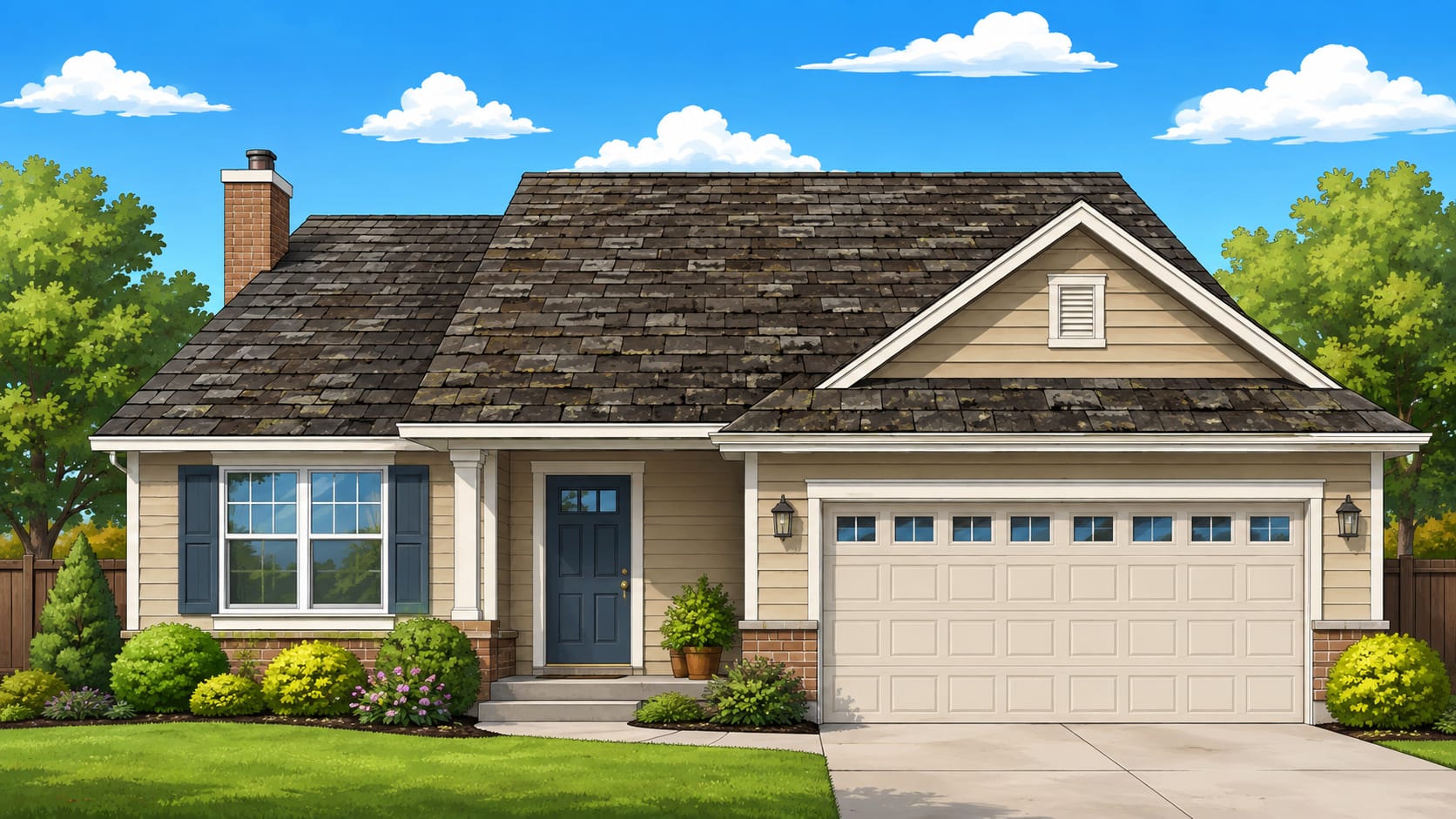
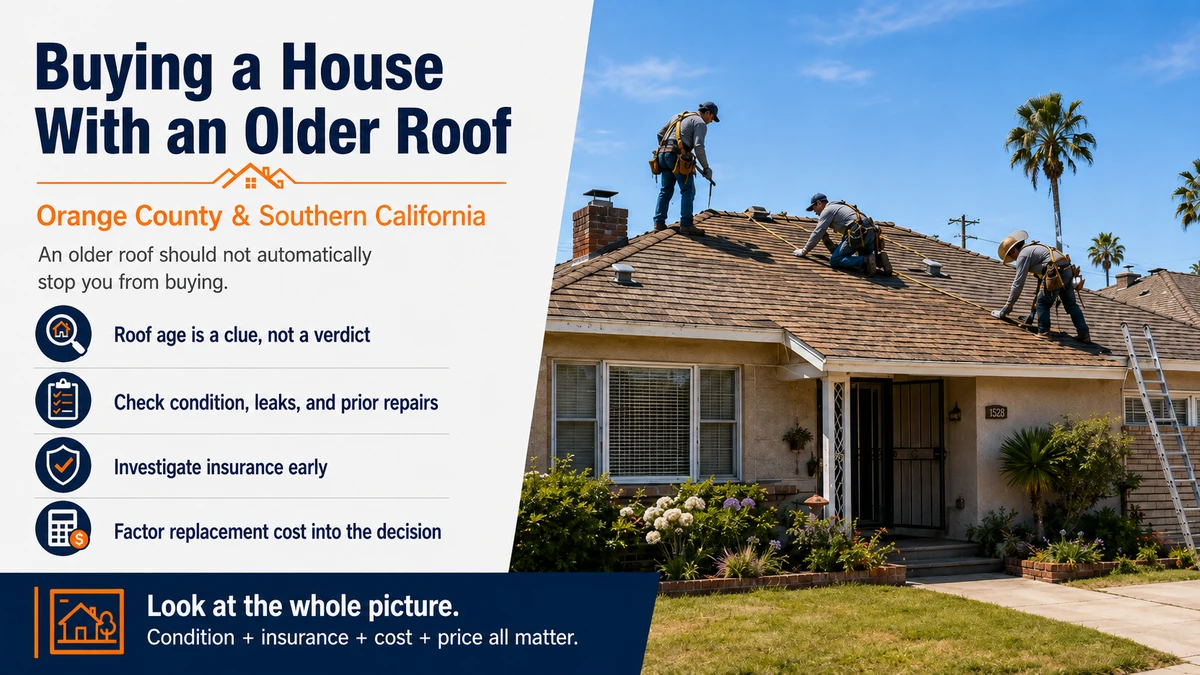
An older roof should not automatically stop you from buying a house.
The more important questions are:
What condition is the roof actually in? Is it leaking? What might replacement cost? Can you insure the home? And does the purchase price make sense given the future expense?
An old roof and a failed roof are not necessarily the same thing.
For the broader buying process, see Buying a Home in Orange County: What Buyers Should Know.
Roof Age Is a Clue, Not a Verdict
Buyers often hear that a roof is a certain number of years old and immediately assume it needs replacement.
Age matters, but it is only one factor.
Roof performance can depend on:
- Roofing material
- Installation
- Maintenance
- Sun and weather exposure
- Prior repairs
- Flashing
- Ventilation
- Roof penetrations
- Actual physical condition
Roof manufacturer GAF specifically says asphalt shingles do not have one fixed expiration date and that weather, location, moisture, UV exposure, material and installation can all affect performance. Its current guidance also gives very broad useful-life ranges depending on roofing type, reinforcing why age alone is not enough to make the decision.
In our own transactions, we have encountered composition roofs approaching 50 years old that still had no known leaks.
That does not mean buyers should expect every composition roof to last 50 years.
It means you should investigate the roof rather than automatically assuming:
Old = failed.
Different Roof Types Age Differently
"The roof is 25 years old" means different things depending on what is actually on the house.
Orange County buyers may encounter:
- Composition shingles
- Concrete or clay tile
- Flat or low-slope roofing
- Combinations of different roofing systems
Tile roofs deserve particular attention because the visible tile is only part of the system. Underlayment, flashing and other waterproofing components can have different conditions from the tile itself.
A roof can therefore look relatively good from the street while still deserving further investigation.
This is one reason buyers of older properties should evaluate major systems individually rather than judging the house entirely by its age. See Buying an Older Home in Orange County: What Should You Inspect?.
Pay More Attention to Condition Than the Calendar
Some findings deserve more attention than the roof's birthday.
These can include:
- Active leakage
- Interior water staining
- Missing or damaged roofing materials
- Deteriorated flashing
- Extensive patching
- Sagging or other structural concerns
- Moisture intrusion
- Poor drainage
- Widespread deterioration
GAF similarly identifies leaks, missing or deteriorated materials, excessive granule loss, damaged flashing and sagging as conditions that may justify professional evaluation.
A general home inspector may identify visible concerns.
If the roof is particularly old, has signs of leakage, has substantial prior repairs, or its condition could affect insurance, getting a qualified roofer's opinion may provide more useful information.
Buyers should not attempt to walk or inspect a roof themselves.
Insurance May Be a Bigger Issue Than the Roof Itself
California's insurance market has made roof condition more important during a real estate transaction.
We have seen a homeowner lose insurance coverage after exterior imagery appeared to show lichen or similar growth on part of a two-story roof.
The area was north-facing and heavily shaded.
The visible condition did not itself establish that the roof was leaking or had failed, but it was still enough to create an insurance underwriting issue.
This is not just theoretical. The California Department of Insurance has documented increasing insurer use of aerial and satellite imagery and has investigated complaints where inaccurate or outdated imagery contributed to coverage decisions involving roof condition.
That makes the practical lesson simple:
If the roof may raise an insurance question, investigate insurance early.
Sometimes cleaning or documenting the actual condition can be worthwhile even if a roofer does not believe the roof needs replacement.
Replacement Cost Has to Be Part of the Purchase Decision
Even if an older roof is functioning today, buyers should prepare for the possibility that replacement will be needed during their ownership.
Recent Legacy projects and estimates cited in our ownership-cost analysis have been around:
$15,000 for a smaller single-story composition roof
and closer to:
$25,000 for some two-story homes
depending on size, access and condition.
Those are firsthand examples, not Orange County roofing averages. Actual cost can change substantially based on material, tear-off requirements, decking damage, pitch, complexity, labor and other conditions.
That expense should be considered alongside the rest of the house.
A $950,000 home needing a roof soon could still be a better purchase than a $975,000 home with a newer roof but aging HVAC, plumbing and electrical systems.
This is why The True Cost of Owning a Home in Orange County matters more than simply comparing purchase prices.
A Real Roof Negotiation
We recently worked with a buyer on an entry-level house in Corona.
The roof was an issue, and instead of accepting approximately a $10,000 credit toward dealing with it after closing, the buyer wanted the seller to replace the roof.
The buyer was purchasing with a relatively low down payment and did not want to take ownership and immediately manage a large roofing project.
The seller agreed to complete the roof.
The transaction closed successfully and both sides were satisfied with the resolution.
The important point is that a credit is not always the best solution.
Sometimes the buyer wants cash flexibility.
Sometimes the buyer wants a lower price.
And sometimes the buyer simply wants the major project completed before moving in.
Should You Ask the Seller for a New Roof?
It depends on what the investigation actually shows.
A buyer could potentially:
- Accept the roof as-is
- Request specific repairs
- Ask the seller to replace it
- Request an allowable seller credit
- Negotiate the purchase price
- Investigate further before deciding
The right strategy depends on the roof condition, estimates, insurance, financing, purchase price, market leverage and the terms of the transaction.
See Should You Ask the Seller to Make Repairs After a Home Inspection? for a broader look at inspection negotiations.
Also remember that a $15,000 price reduction is financially different from receiving $15,000 toward allowable closing expenses. A lower purchase price does not generally leave the buyer with $15,000 of additional cash available immediately after closing.
The difference is explained in Seller Credits vs. a Lower Purchase Price: Which Is Better for Buyers?.
Solar Panels Can Complicate an Older Roof
Solar deserves special attention when evaluating an aging roof.
Many rack-mounted solar systems involve attachments or penetrations through the roofing assembly. Those penetrations do not automatically cause leaks, but proper flashing and waterproofing are important because roof penetrations are particularly vulnerable areas for water intrusion. U.S. Department of Energy guidance specifically emphasizes flashing and sealing penetrations.
Before buying a house with both an older roof and solar, consider:
- How the solar was installed
- Whether there is evidence of leakage
- Roof condition underneath and around the system
- Whether panels would need removal for future roofing work
- Who would remove and reinstall them
- Warranty implications
We have encountered roof problems associated with solar installations, which is why we do not treat the roof and solar system as completely separate issues.
Condo and Townhome Buyers Need to Ask Who Owns the Roof Problem
Do not assume the HOA pays for the roof simply because you are buying a condo or townhome.
California DRE notes that roof maintenance responsibility can vary according to the governing documents, and in some developments individual owners may be responsible even for roofs associated with common-area ownership.
We have also encountered communities where installing rooftop solar can change an owner's future roof-maintenance responsibility.
That is property-specific and needs to be confirmed in the actual governing documents.
If the HOA is responsible for the roof, investigate:
- Reserve funding
- Roof replacement plans
- Recent repairs
- Upcoming projects
- Possible assessments
See How to Review HOA Financials Before Buying a Condo.
Before Buying a House With an Older Roof, Ask:
- What roofing material is it?
- Approximately how old is it?
- What is its actual current condition?
- Is there evidence of leakage or prior water intrusion?
- What repairs have already been made?
- Would a roofing specialist evaluation be useful?
- What would replacement likely cost for this property?
- Can you obtain acceptable homeowners insurance?
- Are solar panels involved?
- Who maintains the roof if there is an HOA?
- Are other expensive systems also approaching replacement?
- How much cash will you have available after closing?
- Does the purchase price reasonably reflect the home's condition?
An old roof becomes much easier to evaluate once those questions have answers.
Legacy Real Estate Insights
For more Southern California housing data, ownership-cost analysis, and practical real estate trends, visit Legacy Real Estate Insights.
Looking at a Home With an Older Roof?
An older roof does not automatically make a home a bad purchase.
Legacy Real Estate can help Orange County buyers evaluate the roof in the context of the entire property, coordinate appropriate inspections, investigate insurance early, compare anticipated expenses, and determine whether the home's price and overall condition still make sense.
The goal is not to find a house where every component is new.
It is to understand what you are buying, what expenses may be approaching, and whether you are financially comfortable with them.

Legacy Real Estate does not provide roofing, contracting, engineering, insurance, lending, legal, or HOA advice.